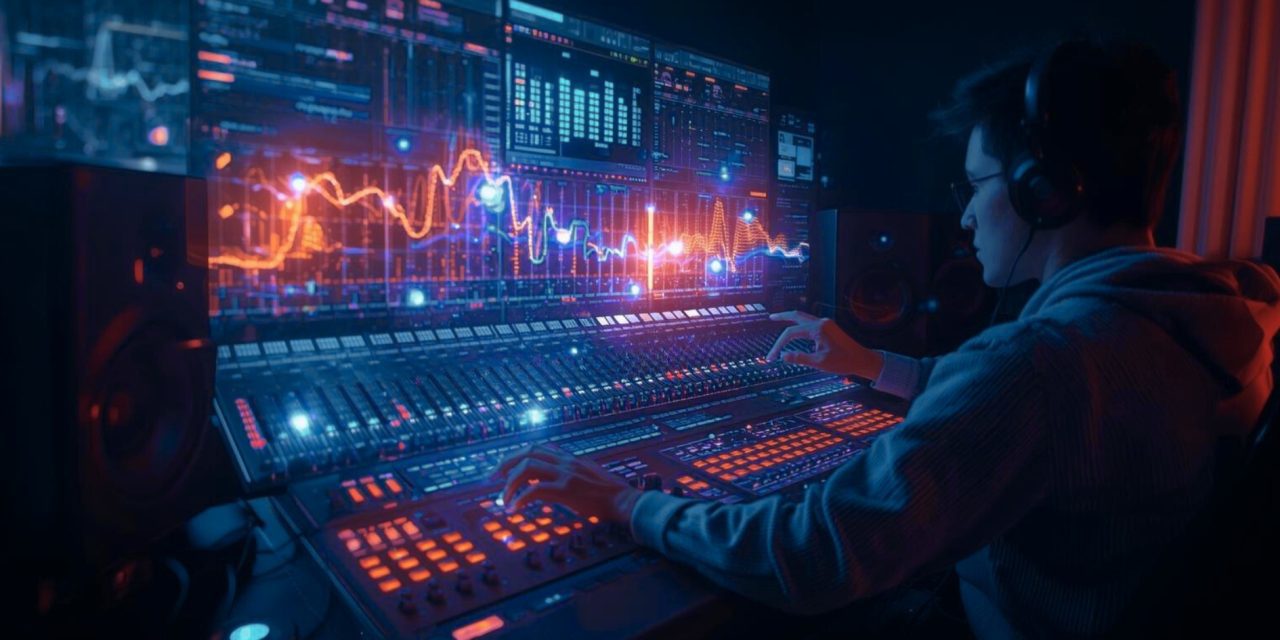
Imagine adjusting a mix before you touch the fader. Or dragging a vocal through thin air and hearing it move in 3D space. Or opening a plugin that already knows how you mix.
That is not a sci-fi trailer. It is the direction of music production in 2026.
Three emerging gear categories are reshaping producer workflows: neural audio interfaces that read intent, holographic monitoring systems that visualize sound spatially, and adaptive plugin ecosystems that learn your mixing behavior. These tools do not just process audio. They anticipate decisions, accelerate iteration, and reduce creative bottlenecks.
The result is predictive mixing, immersive spatial control, and workflow optimization that moves at the speed of ideas instead of the speed of menus.
Neural Audio Interfaces
Neural audio interfaces introduce biometric input into music production. As an example, Neural DSP’s NeuroInterface uses eight-channel EEG plus EMG sensors to detect “creative flow state.” It auto-adjusts gain staging approximately 300 milliseconds before a fader touch. That timing difference reduces friction during automation-heavy sessions.
The system relies on machine learning models trained across producer sessions. Core features include auto-mixing, emotion-based recall, and gesture prediction. These tools accelerate transitions from beatmaking to final polish.
In prototype testing, a producer like Skrillex reportedly reduced mix time by streamlining automation and sidechain tasks. DAW integration allows biometric feedback during real-time collaboration.
Practical steps include calibrating sensors during warm-ups. Use predictive mixing in remote studios or VR production setups. This adaptive gear enhances production efficiency without creating a steep learning curve.
Holographic Monitoring Systems
Holographic systems transform how producers perceive spatial audio.
The Holoplot X1 ($12K) matrix array creates 512 individually addressable sound objects with ±0.5-degree precision across 3,072 channels. This enables advanced holographic mixing beyond traditional stereo fields.
Paired with Apple Vision Pro ($3,499), producers can view soundwaves in three dimensions. Integration with Spatial Audio Workstation software allows gesture-based production. Drag a vocal 15 degrees left in the hologram and hear immediate spatial movement.
These systems support object-based audio, binaural rendering, and Dolby Atmos workflows. Research suggests improved mix translation across playback systems due to clearer spatial mapping.
For practical workflow optimization, begin sessions by mapping stems in 3D space. This reframes creative constraints as spatial opportunities. Holographic systems are especially suited for immersive audio, metaverse studios, and avatar collaboration environments emerging in 2026.
Adaptive Plugin Ecosystems
Adaptive plugin ecosystems redefine how plugins behave within hybrid setups. They analyze, predict, and evolve.
Plugin Alliance’s MEGA Bundle 2026 ($399) analyzes up to 23 tracks to build a predictive signature model. It adapts EQ curves and processing decisions based on learned mixing patterns.
Brainworx bx_digital V3 introduces adaptive auto-Q adjustments informed by prior sessions. Tokyo Dawn Nova 3 Dynamic EQ applies predictive compression behavior in real time.
Testing metrics show fewer parameter changes and faster mix completion. This reduces repetitive tweaking while preserving creative control.
Use adaptive plugins for multiband processing, parallel processing, and bus processing. They integrate seamlessly with hardware controllers inside hybrid workflows.
To maximize results, load 20 completed mixes early to train the system. Apply adaptive modeling to sound design sessions or mastering tools for full workflow optimization.
This gear choice directly improves productivity during track production and release preparation.
Conclusion
Creativity used to depend on how fast your hands could move. Now it increasingly depends on how intelligently your tools respond.
Neural interfaces predict. Holographic systems visualize. Adaptive plugins evolve. Together, they shift production from reactive tweaking to proactive creation.
Are you building a workflow that thinks with you, or are you still fighting menus and automation lanes? Join the producers upgrading their creative edge and stay ahead of next-gen production tech only at DLK Music Pro News.