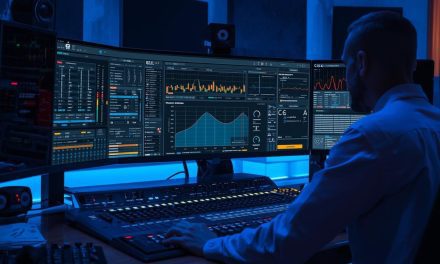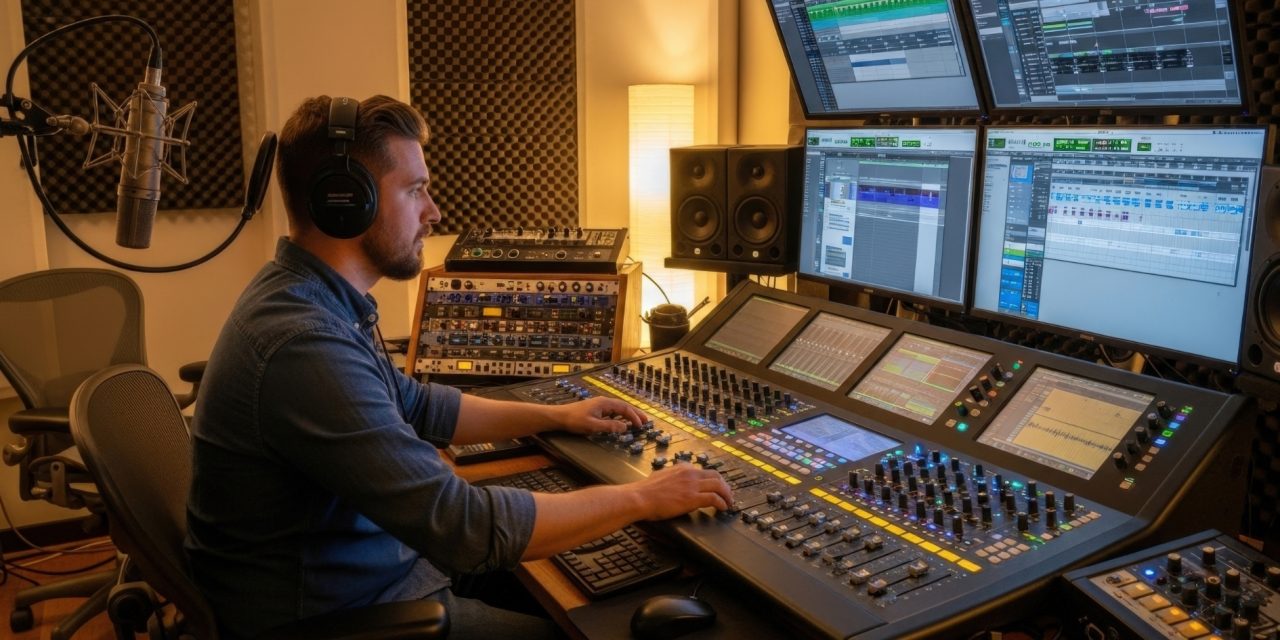
As AI continues to accelerate music production workflows, one reality remains unchanged: professional results still depend on physical studio gear. While cloud-based plugins and generative tools dominate idea creation, essential hardware continues to define sound quality, capture accuracy, and session efficiency—especially for producers aiming beyond demo-level output.
This isn’t a debate about nostalgia versus innovation. It’s about understanding which studio tools still matter when AI handles speed, but not nuance. From condenser microphones to low-latency audio interfaces, certain pieces of studio gear remain foundational—not optional—as production standards evolve toward 2026.
AI Advances vs. Physical Gear Needs
AI-generated music exploded in 2025, with composition tools producing over 1.2 billion tracks. Yet during the same period, Neumann U87 microphone sales reportedly rose by 18%, signaling continued demand for authentic sound capture. AI excels at generating ideas quickly, but it often delivers compressed dynamics and generic tonal balance that require extensive post-processing.
Physical studio gear fills that gap. Hardware microphones capture subtle vocal details—breath, proximity, room interaction—that AI struggles to replicate convincingly. Rather than replacing microphones and preamps, AI often forces producers to compensate with layers of effects that never fully recreate a natural performance.
Several popular AI tools illustrate these limitations in real sessions. Suno generates catchy demos but demands heavy editing for professional polish. AIVA offers orchestral sketches with limited expressive depth. Udio creates beats rapidly, yet its stems lack the dimensional weight achieved through hardware-based production like Akai MPC workflows. The result is clear: AI assists ideation, but physical gear anchors quality.
A future-proof studio embraces a hybrid model—AI for speed and inspiration, paired with condenser microphones, clean preamps, and reliable audio interfaces for core capture. This balance keeps producers competitive well beyond 2026.
Producer Workflow Realities
Workflow efficiency remains one of the most underestimated factors in music production. During Andrew Huang’s widely discussed 100-day challenge, producers spent nearly 68% of their time on sound selection and setup, not composition. The bottleneck wasn’t creativity. Rather, it was unreliable gear and technical friction.
Frequent issues include unstable connections, latency problems, and inconsistent monitoring. Producers routinely lose hours each week troubleshooting instead of creating. Timeless studio gear like the Shure SM7B microphone and Focusrite Scarlett interface consistently reduce these disruptions by offering stable performance and predictable signal flow.
With dependable tools, setup time drops dramatically. One producer from Mix with the Masters noted that reliable microphones and interfaces allowed sessions to start immediately, keeping creative momentum intact. That consistency is what turns a studio into a workspace rather than a problem-solving lab.
Common workflow obstacles—cable clutter, latency, and mic instability—are solved with intentional gear choices. Investing in low-latency interfaces, solid mic stands, and organized routing doesn’t just save time; it preserves creative energy. In an AI-enhanced future, efficiency will separate productive studios from overwhelmed ones.
Conclusion
AI will continue to reshape how producers generate ideas, but it won’t replace the tools responsible for capturing, monitoring, and shaping sound at a professional level. Physical studio gear remains the backbone of serious production. This is not because technology stalled, but because sound quality still demands precision, control, and reliability.
The producers who thrive in 2026 won’t abandon hardware. They’ll integrate it intelligently, letting AI accelerate creativity while essential studio gear protects the integrity of the final result.
If AI can write the song in seconds but your gear shapes how it actually sounds, which part of your setup is truly doing the heavy lifting? DLK Music Pro News explores the tools, workflows, and decisions producers rely on when quality still matters.