For a long time, sounding professional required a professional-sized budget and a strong tolerance for gatekeeping. If you didn’t have racks, rooms, and receipts, you were expected to settle for “good enough.” That reality is changing fast. This piece explores how 2026-era gear is closing the pro studio gap, not through hype, but through real shifts in cost, power, and access.
What once separated elite studios from home creators is no longer as clear-cut. Hardware, software, and workflows are converging in ways that favor capability over credentials. Understanding how we got here matters before predicting where it goes next. The playing field isn’t just leveling, it’s being rebuilt.
The Historical Pro–Am Divide
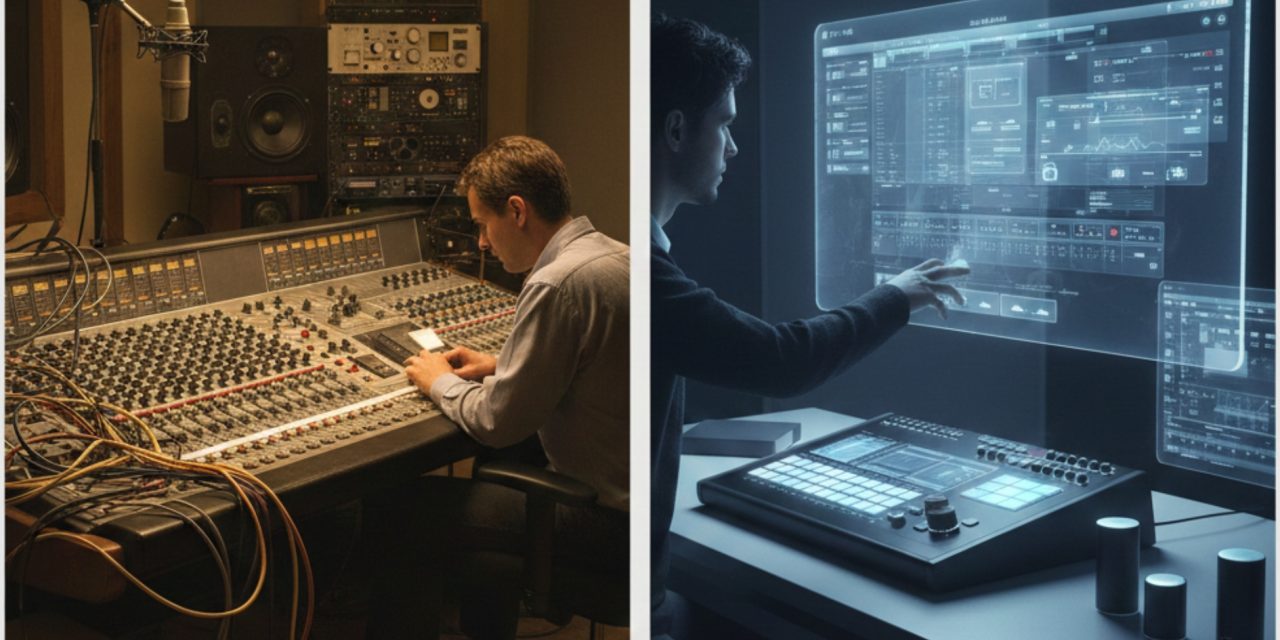
In 2005, a basic professional vocal chain told a clear story. A Neve 1073 preamp paired with an LA-2A compressor could cost around $15,000. Meanwhile, most amateurs relied on $99 M-Audio interfaces with limited headroom and noise floors near 90 dB. The quality gap was obvious and structural.
By 2000, entering professional audio often meant buying into Pro Tools HD systems costing roughly $25,000. Home producers worked with budget mixers, entry-level microphones, and unstable setups. Sound on Sound archives document how these costs locked out independent artists. Professional sound was guarded by hardware and price.
That divide began shrinking in the 2010s. DAWs like Ableton Live and Logic Pro reduced reliance on proprietary hardware. Minimum viable setups dropped to about $5,000. By 2020, creators could enter with roughly $1,000 using interfaces from Focusrite and Universal Audio.
Pro Studio Access Timeline
- 2000: ~$25K entry (Pro Tools HD dominance)
- 2010: ~$5K minimum (DAW software matures)
- 2020: ~$1K entry (USB-C interfaces and plugins)
Plugin emulations of Neve, SSL, and API consoles further blurred the line. Sound quality became less about location and more about workflow. The pro–am divide didn’t vanish overnight, but it clearly began to collapse.
2026’s Democratization Shift
By 2026, hardware economics accelerate that collapse. Moore’s Law combined with manufacturing scale continues to drive prices down by an estimated 30% annually. Devices like the Neural DSP Quad Cortex at $1,699 now replace guitar rigs that once exceeded $100,000. Capability no longer tracks with cost the way it used to.
Advances in semiconductor fabrication, including TSMC’s 2nm process, enable smaller and more efficient chips. These gains power audio gear with processing headroom once reserved for commercial studios. AI-assisted consoles, smart interfaces, and real-time processing move into reach for home creators. Bedroom studios gain tools that would have been unthinkable a decade earlier.
Supply chains are stabilizing as well. AES 2025 highlighted recovery from chip shortages that previously slowed production. Interfaces, monitors, and controllers now scale reliably. Indie musicians can build capable studios without waiting months or paying inflated prices.
As one Gearslutz forum contributor put it, “2026 technology finally levels the playing field.” DAWs like Ableton Live paired with modern USB-C interfaces deliver low-latency, high-fidelity workflows. Professional results are no longer tied to professional addresses. Access, not pedigree, is becoming the deciding factor.
Conclusion
The pro studio gap was never just about talent. It was about access to reliable tools, stable workflows, and scalable power. From five-figure hardware barriers to four-figure entry points, the shift has been gradual but unmistakable. By 2026, professional capability is defined less by ownership and more by how tools are used.
This democratization raises new questions for the industry. Audio is only one part of the story. Visual production, computing power, software design, hardware integration, and modern workflows are all evolving in parallel. In future pieces, we’ll break down how each of these areas is reshaping what “professional” really means.If professional quality is no longer reserved for professional studios, what actually separates creators now? Stay with DLK Music Pro News as we continue exploring how audio, visual, computing, software, hardware, and workflows are redefining the creative industry.