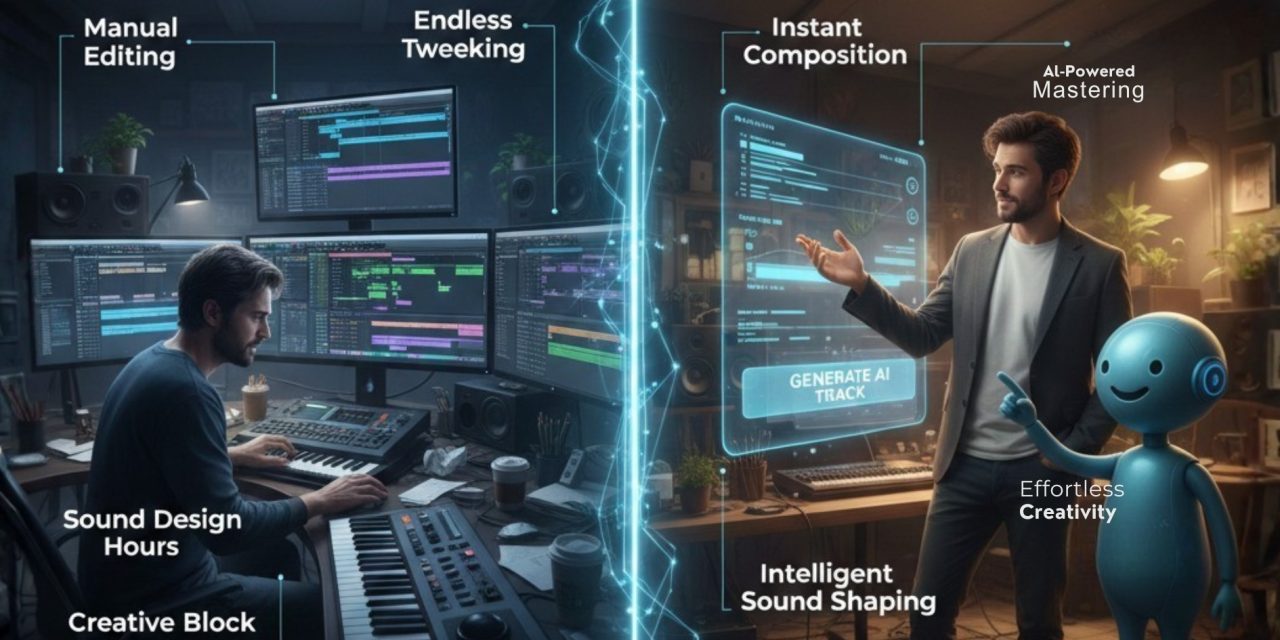
If producing music in 2020 felt like a four-hour relationship with your DAW, that wasn’t inefficiency, it was the norm. Endless tweaking, manual routing, and constant decision fatigue defined the process. By 2026, that grind has shortened dramatically, not because producers work less, but because workflows work smarter. This article examines how producer workflows evolved between 2020 and 2026, and why gear choices now directly shape creative momentum.
The shift isn’t just about faster tools. It’s about removing friction from the idea-to-output pipeline. AI-assisted plugins, hybrid setups, and intelligent gear now handle repetitive tasks. Producers regain focus where it matters most: creative decisions.
From Analog Holdouts to AI-Native Pipelines
In 2020, many producers built sessions around hardware synths like the Moog Mother-32. Programming patches, syncing hardware, and committing takes consumed hours per track. By 2026, AI-native tools such as AIVA Pro and Orchestral Tools’ Neural Synthesizer dominate early-stage creation. Instant concepting replaces manual programming.
The workflow shift is measurable. What once took four hours per track now averages closer to 45 minutes. Plugin ecosystems like Arturia V Collection helped bridge the gap by emulating analog warmth efficiently. At the same time, AI tools then removed remaining bottlenecks in sound design and arrangement.
Workflow Evolution Snapshot
- 2020: Hardware synth dominance — ~4 hours per track
- 2023: Plugin emulations rise — ~2.5 hours per track
- 2026: Neural AI generators — ~45 minutes per track
A practical approach has emerged. Producers often prototype ideas using neural generators, sometimes from voice sketches. These concepts then feed into hybrid setups with modular or analog gear. The result is faster iteration without sacrificing sonic character.
Key Tech Shifts Reshaping Daily Routines
Several technology shifts reshaped daily production routines between 2020 and 2026. Thunderbolt 5 drastically reduced latency while increasing bandwidth for high-fidelity audio transfers. Wireless MIDI 2.0 enabled stable control across large spaces, supporting remote and portable studios. These changes prioritize uninterrupted creative flow.
Edge AI processing further accelerated workflows. Local neural processing units handle predictive mixing and mastering without cloud delays. At the same time, 5G-enabled DAWs allow real-time collaboration on large projects, including spatial audio and Dolby Atmos sessions. Sharing no longer breaks momentum.
Haptic controllers added a physical layer back into digital production. Tactile feedback improves accuracy in automation and bus processing. Research suggests these tools increase precision during complex mix moves. Paired with neural interfaces, they reduce guesswork.
Actionable strategies are already clear. Test wireless MIDI with grooveboxes for travel-friendly sessions. Combine edge AI tools with stem separation for rapid remixing. These shifts reward gear ecosystems built for integration, not isolation.
Conclusion
Between 2020 and 2026, producer workflows didn’t just speed up, they fundamentally reorganized. Manual DAW grinding gave way to AI-assisted pipelines that protect creative energy. Gear choices now influence how fast ideas move from concept to release. Efficiency has become a creative advantage, not a technical concern.
This evolution continues to ripple outward. Workflow changes are tied to software intelligence, hardware design, computing power, and collaboration models. Understanding how these pieces interact is now essential for modern producers. Future pieces will explore how to build these systems intentionally.
If workflows now shape creativity as much as talent, what is your current setup actually optimizing for?
Stay with DLK Music Pro News as upcoming pieces break down the tools, systems, and gear strategies driving modern producer workflows.