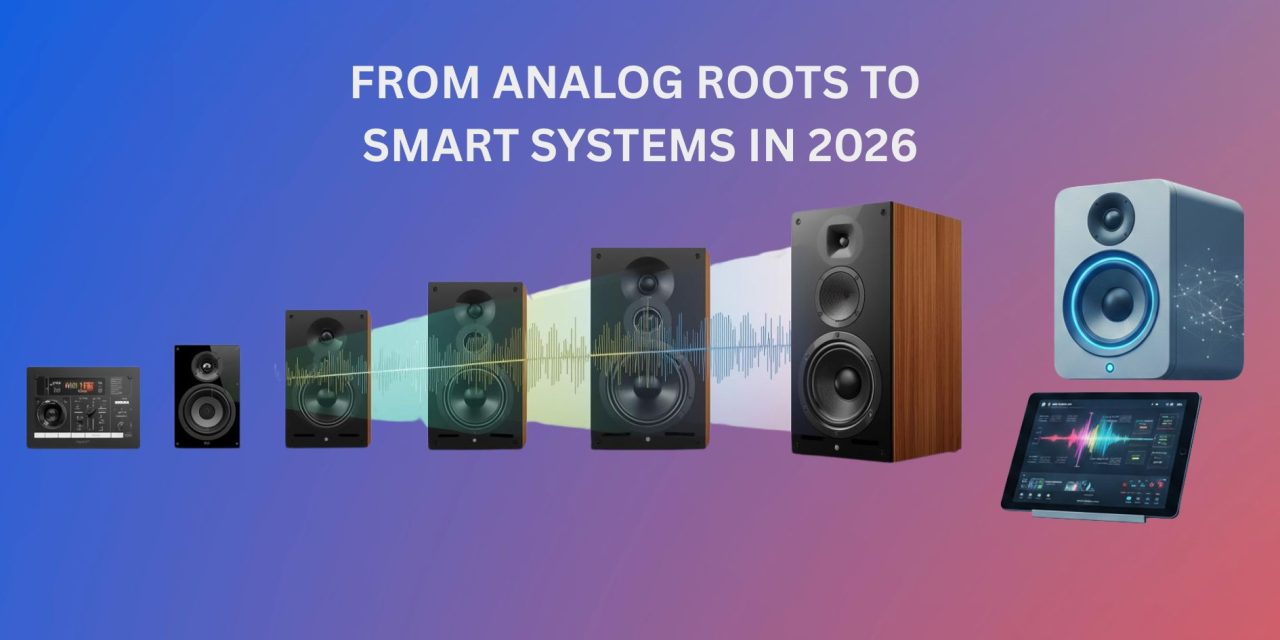
Every sound engineer has blamed the speakers at least once. Sometimes it was fair. Sometimes it was denial wearing studio headphones. Studio monitoring has quietly shaped how music is mixed, judged, and trusted for decades. As playback systems multiplied, monitors were forced to evolve just to keep up.
By 2026, they do far more than play sound back. This article looks at how studio monitoring evolved from analog designs into DSP-powered smart systems, and why that evolution changed mix accuracy forever.
From Analog to Digital Eras
The 1970s through 1990s marked the analog foundation of studio monitoring. Passive speakers like the Yamaha NS-10M, released in 1978, defined nearfield monitoring. Its paper-cone drivers and aggressive treble exposed mix flaws with brutal honesty.
Despite room interaction issues, the NS-10M became an unlikely industry standard. An AES Volume 42 paper famously noted its survival despite technical shortcomings. Engineers trusted it because poor mixes sounded bad everywhere.
The 1980s introduced active monitors that solved power inconsistencies. Genelec 1031As integrated amplifiers directly into the speaker design. This ensured consistent performance and improved reliability across studios.
By the 1990s, dome tweeters replaced horn designs. This shift delivered smoother high-frequency detail and reduced listener fatigue. However, passive and early active monitors still struggled with room modes and uneven bass response.
Nearfield monitors forced analytical listening within small sweet spots. Midfield systems improved the soundstage but required heavy acoustic treatment. The transition to digital introduced DSP as a solution to these long-standing pain points.
Key Milestones Leading to 2026
Several innovations pushed studio monitoring toward today’s smart systems. Each milestone addressed accuracy, consistency, and mix translation across playback environments.
- 2005: Genelec SAM technology introduces DSP room correction with automated calibration. This reduces manual EQ and improves low-frequency control.
- 2010: Neumann KH 120 DSP debuts with digital control and consistent phase behavior. Engineers gain repeatable results across different rooms.
- 2012: Meyer Sound CAL column arrays pack 96 drivers for even dispersion in large spaces. This design improves clarity and transient response.
- 2017: Dutch & Dutch 8c launches cardioid bass control, minimizing rear wall interaction. Bass accuracy improves without excessive acoustic treatment.
- 2020: Kii Three active DSP systems use six amplifiers for precise driver control. Distortion drops while imaging and low-end accuracy increase.
- 2023: Dirac Live integration becomes standard, optimizing frequency response and phase alignment. Sound On Sound measurements confirm tighter transients and improved translation.
These milestones lead directly to 2026 smart studio monitors with AI-assisted calibration. Midfield and farfield designs now feature improved waveguides and wider sweet spots. Mixes translate more reliably to streaming platforms, headphones, car audio, and club systems.
Conclusion
The evolution of studio monitoring reflects the industry’s demand for accuracy and consistency. Analog systems revealed flaws through limitation. DSP-powered monitors now solve problems before they reach the mix stage.
By 2026, engineers will benefit from fatigue-free monitoring, flat response, and precise imaging. These advances support both home studios and professional environments. Studio monitoring is no longer reactive. It is intelligent, adaptive, and deeply integrated into modern production workflows.
Has the evolution of studio monitoring changed how you trust your mixes across different playback systems? Let us know in the comments and be sure to keep up with monitoring technology and production trends only at DLK Music Pro News!