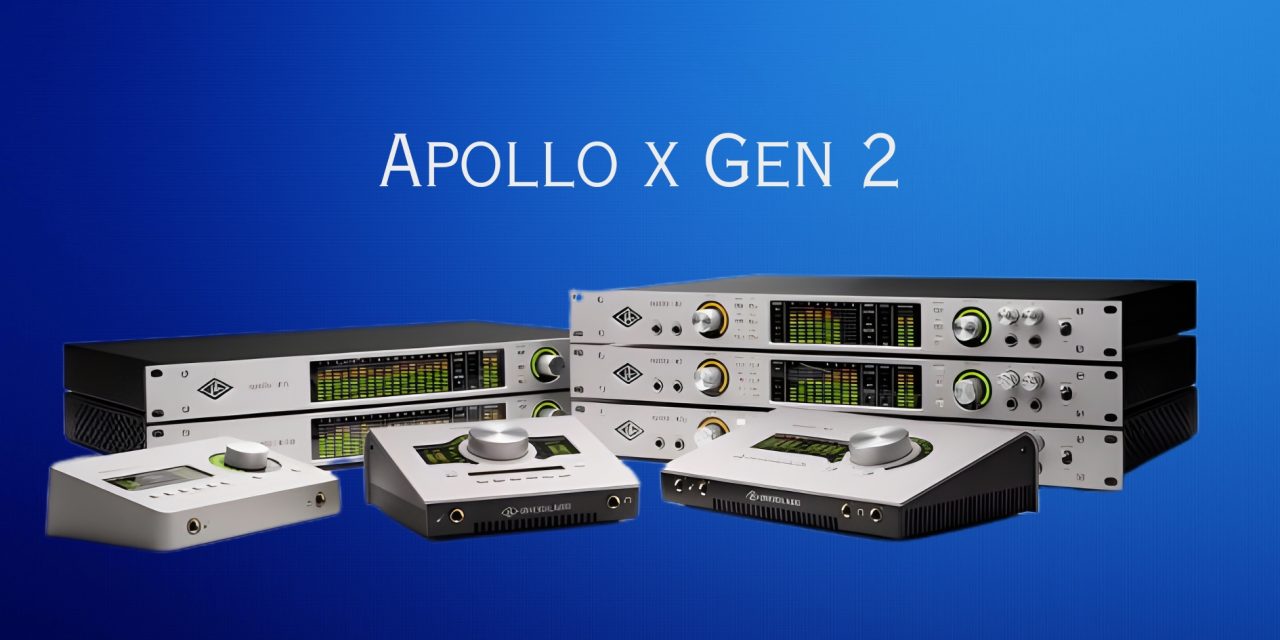
Capturing every vocal nuance and guitar transient without second-guessing your interface is no longer a luxury reserved for flagship studios. The Universal Audio Apollo x Gen 2 brings console-level precision into modern production spaces, delivering uncompromising sound quality without slowing creative momentum.
Building on earlier Apollo generations, Gen 2 raises the bar with elite AD/DA conversion, expanded DSP power, and Thunderbolt 4 performance that holds up under real-world session pressure. Against competitors like Focusrite and RME, its edge isn’t just on paper. Rather, it’s felt in latency, tone commitment, and workflow confidence.
What Makes It a Game-Changer?
Zero-latency UAD plugin tracking fundamentally changes how producers record. Instead of capturing dry takes and fixing tone later, artists commit to sound at the source. Tracking vocals through a Neve 1073 or UA 610 tube preamp emulation in real time captures analog-style warmth without latency penalties.
This shift mirrors classic studio workflows, where tone decisions happen before the mix stage. Apollo x Gen 2 makes that approach practical in modern home and professional studios alike, removing the psychological friction between performance and processing.
Five features define why the Apollo x Gen 2 stands out for music producers and engineers:
- Real-time Unison preamp emulation accurately matches impedance and gain staging of hardware classics on mic and Hi-Z inputs.
- 129dB D/A dynamic range reveals subtle detail across high-resolution sessions up to 24-bit/192kHz.
- Thunderbolt 4 connectivity delivers up to 78Gbps bidirectional speed for ultra-low latency monitoring.
- HEXA Core DSP with 12 SHARC processors powers demanding UAD plugins like the 1176 and Pure Plate Reverb during tracking.
- Console 2.0 auto-gain simplifies gain staging by automatically setting optimal input and output levels.
Together, these features create an analog-style workflow with digital precision. Engineers can re-amp tracks through Unison models post-recording, streamline overdubs, and manage complex sessions directly inside Apollo Console. With UAD Satellite expansion, the system scales comfortably into Dolby Atmos and immersive audio workflows.
Evolution from Previous Generations
Apollo x Gen 2 represents a meaningful leap rather than a cosmetic update. DSP power increases by roughly 33%, moving from 8 to 12 SHARC cores. Thunderbolt 4 doubles effective bandwidth compared to Thunderbolt 3, allowing heavier real-time plugin use without stability issues.
Dynamic range improves, plugin latency drops to approximately 0.7ms, and large sessions feel noticeably smoother. These refinements matter most when tracking through analog emulations across multiple inputs.
| Feature | Gen 1 | Gen 2 |
| DSP Cores | 8 SHARC | 12 SHARC |
| Dynamic Range | 127dB | 129dB |
| Connectivity | Thunderbolt 3 | Thunderbolt 4 |
| Plugin Latency | ~2ms | ~0.7ms |
For engineers running dense sessions with Neve, API, or UA 610 emulations, the upgrade is practical rather than aspirational. Gen 1 users should explore firmware updates first, but Thunderbolt 4 speed and expanded DSP justify the jump for demanding workflows.
Conclusion
The Apollo x Gen 2 isn’t about chasing specs—it’s about removing friction between idea and execution. By combining reliable low-latency performance, authentic analog emulation, and scalable DSP power, it supports confident decisions from tracking through final mix.
For producers who value tone commitment, speed, and consistency, this interface doesn’t just fit modern studios, it defines them.
If your interface still forces you to choose between sound quality and smooth sessions, what’s that hesitation really costing your workflow? DLK Music Pro News breaks down the tools professionals trust when performance, precision, and reliability actually matter.