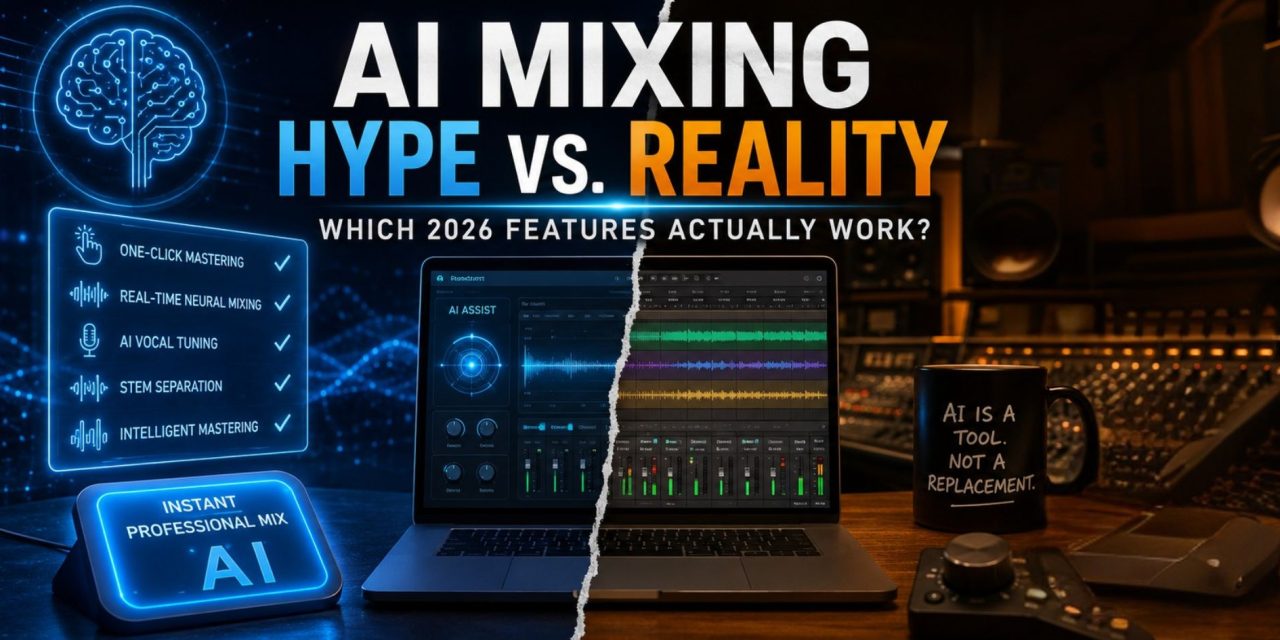
Every year, AI music software promises to make producers wonder whether they’ll ever have to touch another EQ or compressor.
Then reality sets in.
While AI mixing tools continue to improve, not every feature lives up to the marketing. Independent testing and feedback from professional producers show that some headline-grabbing innovations still require ample human guidance to yield truly polished results.
Here’s where the biggest promises stand today.
One-Click Mastering: Helpful, But Not Magical
The promise of instant, professional masters is certainly appealing.
Major platforms continue promoting one-click mastering as a fast solution for creators. While these tools often deliver acceptable loudness levels for streaming, they can struggle with preserving dynamics and adapting to different genres.
| Tool | Marketing Claim | Reality |
| iZotope Ozone | Instant professional masters for every genre | Can over-compress orchestral productions and often benefits from manual adjustments |
| LANDR | Streaming-ready masters in seconds | Performs well on some pop mixes but may reduce dynamic range in hip-hop and EDM |
| eMastered | One-click radio-ready sound | Can struggle with guitar-heavy mixes and complex EQ decisions |
The best results still come from treating AI mastering as a starting point rather than the finished product. Manual adjustments inside Ableton Live, Logic Pro, Reaper, or your preferred DAW often produce a more balanced final master.
Real-Time Neural Mixing Still Has Limits
Real-time AI processing sounds impressive on paper.
In practice, performance depends heavily on your DAW, buffer settings, and system resources.
Current testing shows:
- Ableton Live generally handles neural processing efficiently at lower buffer sizes.
- Logic Pro offers a good balance between latency and stability.
- Pro Tools often requires larger buffers, increasing latency during demanding sessions.
As projects become more complex with virtual instruments, AI assistants, and immersive audio workflows, CPU demands increase significantly.
For many producers, local processing still provides a smoother experience than cloud-based mixing, particularly during recording and low-latency monitoring.
AI Vocal Tuning Isn’t Foolproof
AI-powered vocal correction has improved dramatically.
However, automatic harmony generation and pitch correction still have limitations, especially in more demanding productions.
Common issues include:
- Artificial-sounding pitch correction
- Unnatural formant shifts
- Muddy vocal harmonies
- Phase artifacts in stacked vocals
While AI vocal tools work well for straightforward pop productions, genres that rely on expressive performances—such as EDM, orchestral music, or emotionally dynamic vocals—often benefit from manual editing.
Many professionals still rely on tools like Melodyne alongside AI-assisted workflows to maintain natural vocal character while speeding up the editing process.
Look Beyond the Marketing
Perhaps the biggest lesson from today’s AI mixing landscape is that marketing claims rarely tell the whole story.
Before investing in new software, look for independent reviews, real production demonstrations, and workflow comparisons rather than polished promotional videos. Features like stem separation, vocal isolation, and intelligent mastering continue to improve, but they deliver the best results when combined with an experienced producer’s judgment.
AI has become an incredibly useful studio assistant—but it still isn’t a replacement for trained ears.
Conclusion
The future of AI mixing is undeniably exciting, and every new generation of tools brings meaningful improvements.
At the same time, producers should approach bold marketing claims with realistic expectations. The most effective workflows continue to combine AI’s speed with human creativity, critical listening, and artistic decision-making.
The smartest producers aren’t asking whether AI will replace them; they’re asking which AI tools genuinely help them create better music.
If every AI mixing feature actually worked exactly as advertised, which one would change your workflow the most?
Keep exploring the latest AI production tools, studio technology, and music production insights with DLK Music Pro News.