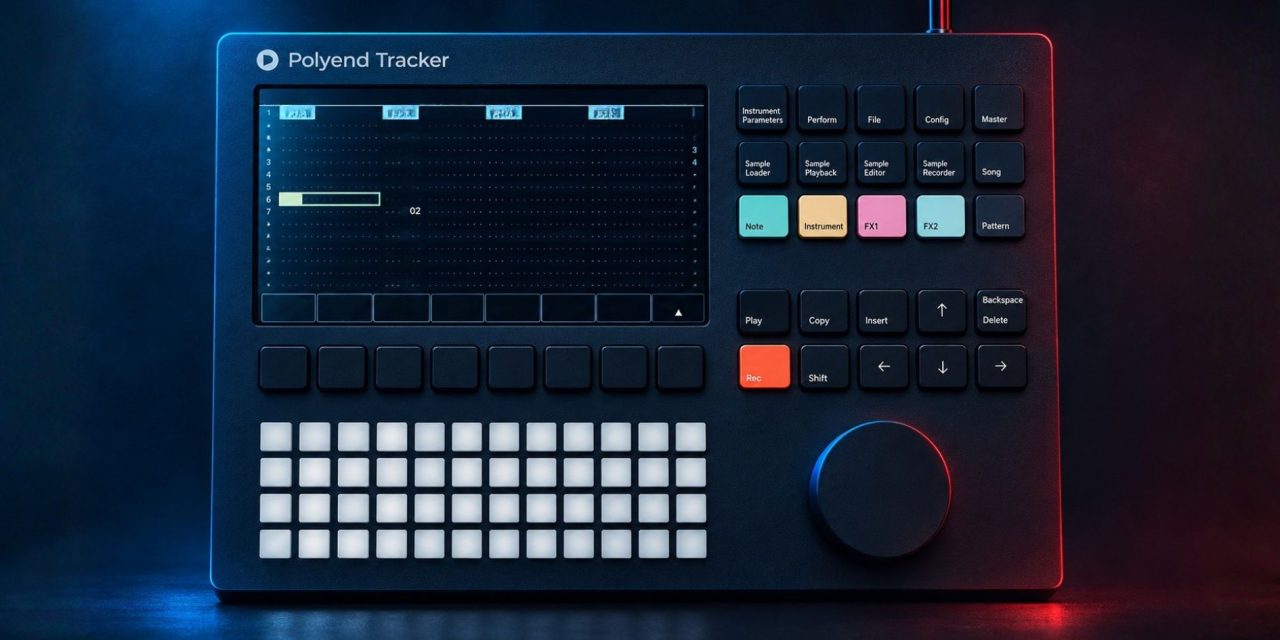
Polyend released Tracker Community Edition 1.0 on November 2, 2026, alongside firmware source code for its Tracker range. The release introduces new sampling and sequencing features across the original Tracker, Tracker+, and Tracker Mini. It also gives developers tools to customize parts of the instruments they already own.
However, not every feature works identically across all three models. The new synth engines, sample-streaming capabilities, and software permissions each have specific limits. Before updating, owners should understand which additions apply to their device, how project compatibility changes, and what the published source code allows.
Polyend’s manufacturer announcement and official Community Edition repository provide the starting point.
More Sampling Flexibility and Step-Level Control
One of the main additions is hybrid SD-card sample streaming, available across all three Tracker models. Instead of loading an entire long recording into sample memory, the system retains its initial attack and streams the remaining audio from the SD card. This makes longer stems, loops, and recordings more practical within a single project.
However, the supported playback modes differ by device. Tracker+ and Tracker Mini can stream One-Shot, Forward Loop, Backward Loop, Ping-Pong Loop, Slice, and Beat Slice instruments. The original Tracker supports streaming for One-Shot and loop modes, but keeps Slice and Beat Slice instruments fully in RAM. Wavetable and Granular instruments also remain in RAM across all three models.
Dedicated Micro-move and Volume fields are another shared improvement. They store timing and velocity information separately from the two step-effect slots. This leaves both effect slots available for other creative uses.
The Sample Editor also gains modular effects and generator plugins across all three devices. These include tools for filtering, stereo delay, sample generation, and other processing tasks.
Tracker+ and Tracker Mini receive two additional synthesizer engines: CHIP and DIRT. CHIP is the first implementation of the new Synth SDK, while DIRT provides wave-shaping and distortion synthesis. Owners of the original Tracker should not assume these engines are included on their device.
Back Up Projects Before Updating
The official changelog identifies an important project compatibility change. Community Edition updates pattern files to Version 6, supporting the dedicated Micro-move and Volume fields.
Existing projects from older firmware can load into Community Edition. However, saving them changes their pattern files to the new format. Older firmware cannot read those saved Version 6 files.
This distinction matters if you might want to return to an earlier firmware version. Loading an older project is not the same as saving it under Community Edition. Once saved, its updated pattern files are no longer backward-compatible.
Polyend recommends backing up the entire Projects folder on your SD card. Alternatively, use Save As to create a separate project copy before experimenting. You can then compare your work against the untouched original.
The repository also documents an emergency recovery option. The Tracker’s isolated bootloader and hardware recovery button allow users to reflash a stable firmware image from the microSD card. However, recovery is not a guarantee against every problem. Community Edition and custom builds come without an obligation of official support, maintenance, or bug fixes.
Published Source Code Does Not Mean Unlimited Permissions
The Community Edition repository provides firmware source code, development tools, and separate licensing terms for different components. Understanding those distinctions matters, especially for developers planning commercial projects.
For musicians, the license expressly permits using the firmware to compose, record, produce, perform, distribute, and monetize music. In other words, releasing or selling music made with the Tracker is permitted.
Developers also have permission to build and sell Sample Editor plugins using the .ptfx SDK. Its MIT license permits commercial plugin development. The Synth SDK and specified source-code components also have MIT licensing, subject to the repository’s restrictions.
However, these permissions do not extend to every part of the firmware. The license prohibits selling compiled Tracker firmware builds or commercial hardware and software clones of the complete Tracker application. It also restricts commercial distribution of the integrated firmware as a standalone product.
Some precompiled synthesizer and DSP libraries remain proprietary. Their terms permit use in authentic Polyend hardware and certain non-commercial projects, but restrict commercial use in third-party products.
The distinction is straightforward: making music, developing permitted plugins, and reusing specific licensed components are different activities. Read the repository license before distributing software, hardware, or modified firmware commercially. Published source code alone does not grant unrestricted reuse rights.
Choose the Update Around Your Workflow
Tracker Community Edition offers practical additions for producers who want more sampling flexibility, expressive step programming, or custom Sample Editor effects. Developers also gain access to plugin-building tools and, on Tracker+ and Tracker Mini, additional synthesizer engines.
The right update decision depends on your device and the features you intend to use. Check the changelog for model-specific differences, back up your projects, and understand the recovery process before flashing new firmware.
For musicians, the new features may change how they approach sampling and sequencing. For developers, the SDKs create a separate opportunity to extend the platform within clearly defined licensing terms.
What could these changes make possible in your next production? Follow more stories about music technology, production tools, and creative development on DLK Music Pro News.