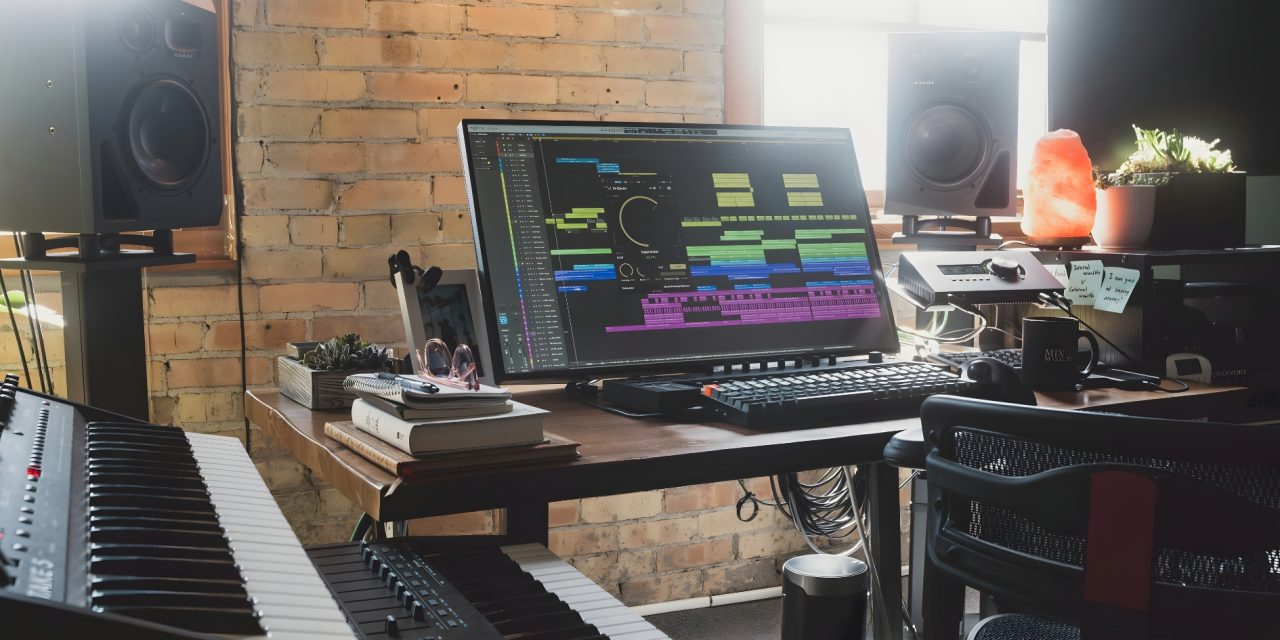
Sometimes music producers talk about their software with the same affection people reserve for pets. And honestly, fair enough—today’s tools feel magical. With the right setup, you can shape ideas, sculpt sound, and build entire sonic worlds without ever leaving your chair. It’s almost unfair how much power a laptop can hold.
Digital Audio Workstations (DAWs)
Your DAW is the command center. It’s where you record, edit, arrange, mix, and sometimes even master. Ableton Live 11 sits at $449 and remains a top choice for electronic producers and live performers. It thrives on flexibility and speed, letting ideas move quickly from concept to reality.
FL Studio, at $199, is a favorite for beatmakers thanks to its intuitive workflow and pattern-based sequencing. Logic Pro X also carries a $199 price tag and offers rich MIDI tools and a large collection of built-in instruments, making it a reliable home for songwriters and producers in pop, rock, and beyond. For full-scale professional environments, Pro Tools stands tall at $599, earning its reputation as the studio standard for editing, post-production, and precision work.
Choosing a DAW ultimately comes down to how you think and create. Genre matters—Ableton often dominates electronic and hybrid setups, while Logic shines in band-oriented styles. But workflow always wins. The best DAW is the one that feels like an extension of your creative mind, supporting rather than slowing your ideas as they take shape.
Virtual Instruments & Creative Plugins
Virtual instruments and plugins expand your musical toolkit without requiring a room full of hardware. Kontakt, priced at $399, gives creators access to thousands of sampled instruments, from delicate pianos to experimental textures. Omnisphere, at $499, pushes deeper into sound design with its massive library and atmospheric versatility.
For orchestral scoring, EastWest Hollywood Strings delivers lush, emotionally expressive string sections that feel cinematic. When a mix needs depth, Valhalla Room offers a $50 slice of reverb heaven, creating stunning spaces with minimal fuss.
Electronic producers often gravitate toward Serum, a wavetable synth known for clarity, punch, and vast modulation options. For more experimental workflows, Output’s Portal transforms audio into something entirely new, acting as a playground for unusual textures and evolving soundscapes. These tools don’t just add sound—they invite exploration. They encourage bold ideas, shaping productions that feel personal and distinct.
Conclusion
Software sits at the heart of today’s creative process. It shapes how producers think, build, and refine their music. Whether you’re working with orchestral textures, sharp electronic leads, or polished studio mixes, the right tools give you space to experiment and grow. With the right combination, you unlock a workflow that feels natural and a sound that feels yours unmistakably.
What software setup could elevate your next production and push your creativity further? Explore more insights, tech picks, and pro-level guidance over at DLK Music Pro News.


