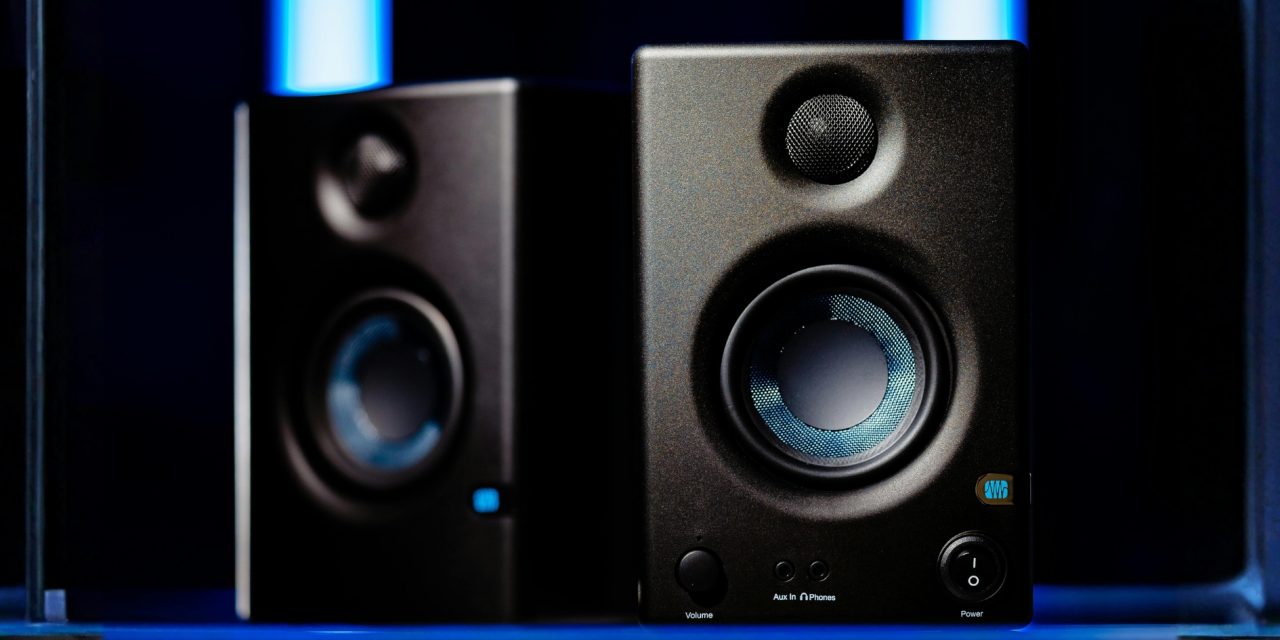
If you have ever finished a mix in headphones, felt proud, then played it in a car and suddenly questioned your life decisions — this article is for you.
Monitoring is not about what sounds “good” at the moment. It is about what translates everywhere else. This piece breaks down the physics-backed advantages of speakers over headphones, from full-range exposure across the 20Hz–20kHz spectrum to stereo imaging, depth perception, room interaction, low latency monitoring, and real-world mix translation.
Don’t get us wrong; we are not saying that headphones are useless. In fact, they are excellent for detailed work and convenience. But they physically cannot replicate room interactions, boundary reinforcement, or natural acoustic imaging. And no plugin or crossfeed simulation fully replaces what speakers reveal.
Full-Range Spectrum Exposure and Imaging Accuracy
Speakers expose the complete 20Hz–20kHz spectrum instantly. Headphones are limited by driver excursion and physical size constraints.
For example, the Neumann KH 750 extends down to 18Hz at 108dB SPL. A Beyerdynamic DT 770 drops closer to 80Hz. That difference matters when evaluating sub energy, crossover frequency impact, and low-end distortion.
Crossover frequency behavior becomes clearer with monitors from Genelec, Focal, or Adam Audio. At 80Hz crossovers, midrange drivers handle punch without distortion. Headphones struggle with low-end dynamic range because small drivers cannot move air the same way speaker drivers do.
Use pink noise or sine wave sweeps for testing. In-room measurement graphs reveal THD and SNR differences in nearfield monitors. This helps calibrate 24-bit audio at 96kHz sample rates accurately.
Equilateral triangle placement, such as with Adam A7Xs, creates a 60-degree sweet spot. This enhances stereo imaging and soundstage accuracy. Waveguide dispersion patterns align with polar response charts in professional setups.
Test with tracks like Steely Dan’s “Aja” or Pink Floyd’s “Money.” You will hear depth and phase coherence differently than in headphones.
Headphones create an isolated stereo field. Speakers create spatial reality. That distinction affects mix translation across car stereos, club systems, and streaming playback environments.
Room Interaction, Translation, and Monitoring Workflow
Speakers interact with the room. That interaction reveals problems that plugins hide.
Strategic placement yields +6dB room gain below 50Hz. Headphones lack boundary reinforcement entirely. Room mode calculations at one-quarter wavelength guide ideal distances. SBIR effects cause dips at wall multiples, fixable through placement and acoustic treatment.
Place nearfields one to two feet from walls. Position them 38% from rear walls when possible. Add bass traps below 80Hz and panels at first reflection points. Measure with an RTA or spectrum analyzer using pink noise.
Isolation pads reduce vibration smear. Mono summing checks phase alignment. SPL meter matching exposes Fletcher-Munson curve effects. These steps support LUFS metering and true peak calibration during mastering.
Speakers enable proper A/B testing with reference tracks. They reveal plugin latency, transducer quality issues, and psychoacoustics balance that headphones often mask.
Low latency monitoring and zero latency direct paths work seamlessly with audio interfaces and DSP processing. This workflow strengthens professional mix checking beyond DAW-only monitoring.
Headphones are excellent for detail work. Speakers are essential for decisions that must be translated everywhere.
Conclusion
Speaker monitoring is not about preference. It is about accuracy, translation, and measurable physics.
Full-range spectrum exposure, stereo imaging precision, room interaction, boundary reinforcement, and calibration workflows give speakers clear advantages in mastering and mix checking. Headphones remain useful tools, but they cannot replace the spatial and acoustic truths speakers reveal.
If your goal is professional sound quality that survives cars, clubs, and streaming compression, speakers remain foundational in modern sound engineering.
Are you actually testing your mixes on speakers before calling them finished? Level up your monitoring game and stay ahead of professional sound engineering workflows only at DLK Music Pro News.


