Let’s be honest—buying a new plugin often feels like adopting a new personality. “This one will make me faster… cleaner… more creative…” Meanwhile, your CPU is sweating and your unfinished projects are quietly judging you.
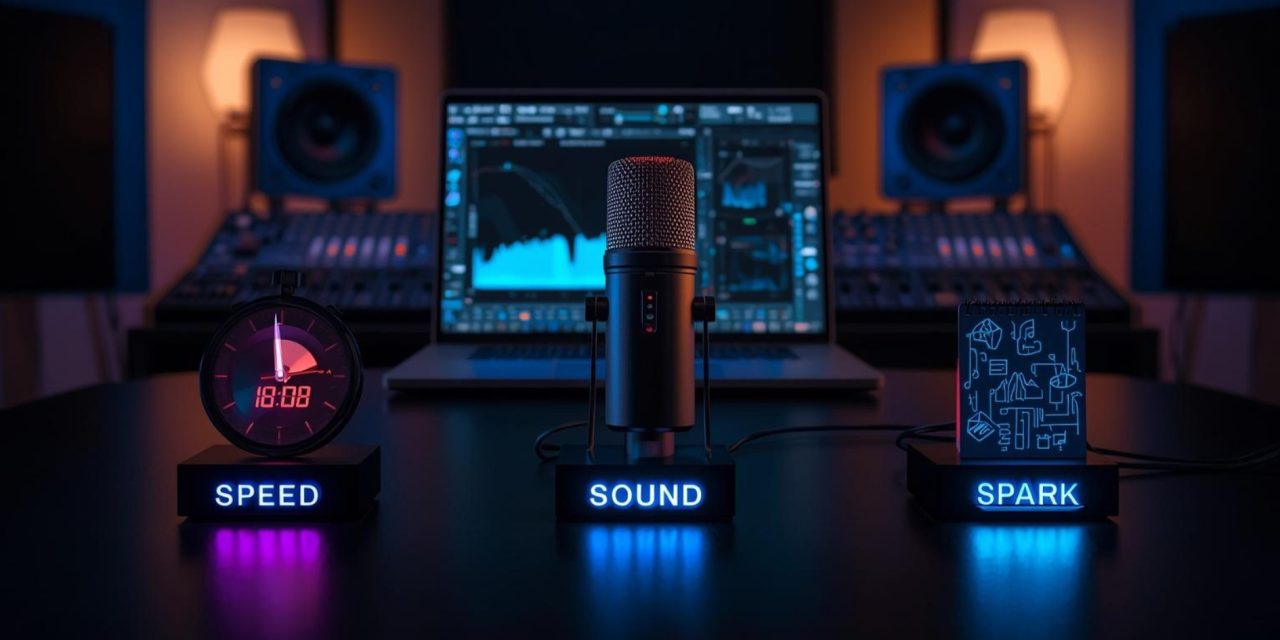
So what are you actually chasing? Is it speed to finally stop missing deadlines, sound quality to compete with pro-level releases, or that rare spark of inspiration that turns a loop into something worth replaying?
In 2026, this isn’t just a casual dilemma—it’s the core of every producer’s workflow. With tighter release cycles, higher streaming standards, and tools promising everything short of making coffee, choosing what really matters has never been trickier.
Let’s break down the three pillars shaping every decision in your setup.
Defining the Core Priorities
Every producer today operates within a three-part framework: speed, sound quality, and creative inspiration. Get the balance right, and your workflow feels effortless. Miss it, and you’re either stuck tweaking forever or finishing tracks that don’t quite hit.
Producers like Metro Boomin emphasize balance—fast ideas still need to sound professional and feel inspired. Meanwhile, Deadmau5 has long pointed out that speed without quality quickly turns into noise, while inspiration without tools goes nowhere.
This “workflow trinity” shapes how producers choose their DAWs, plugins, and hardware. Platforms like Spotify raise the bar for sonic quality, while modern tools push creators to move faster than ever. The real challenge is stacking these priorities in a way that actually works for you.
Speed: Rapid Production Demands
Speed isn’t just a luxury anymore. Rather, it’s survival. Producers working in fast-paced genres or content-driven spaces often need to finish multiple ideas in a single session.
DAWs like FL Studio and Ableton Live dominate here thanks to their loop-based workflows. Compared to more linear setups like Pro Tools, they make it easier to sketch ideas quickly and build arrangements on the fly.
Hardware also plays a role. Controllers like the Ableton Push 3 and Maschine MK3 allow real-time creation without constant mouse clicks. That tactile workflow can shave hours off production time.
The goal isn’t just working fast—it’s capturing ideas before they disappear. Because nothing slows you down more than trying to recreate a vibe you already lost.
Sound Quality: Professional Standards
Speed might get you there, but sound quality decides whether anyone stays. In a streaming-first world, listeners expect clarity, punch, and balance—even from independent producers.
Tools like iZotope Ozone 11 help achieve polished masters with consistent loudness and dynamic range. Pair that with precision plugins like FabFilter Pro-Q 4 and classic emulations from Waves Audio, and you’re building mixes that translate across platforms.
Top engineers like Andrew Scheps rely on structured chains—EQ, compression, saturation, limiting—to maintain consistency. But beyond the tools, it’s about critical listening: referencing tracks, managing headroom, and making intentional choices.
Because in 2026, “good enough” rarely cuts through. Clean, balanced, and dynamic is the baseline—not the bonus.
Creative Inspiration: The Innovation Edge
This is the wildcard—the one thing you can’t fully systemize. You can have the fastest workflow and the cleanest mix, but without inspiration, the track just sits there.
Advanced instruments like Omnisphere and Serum open up massive sound design possibilities. Platforms like Output Arcade keep fresh ideas flowing with constantly updated content.
Artists like Flume are known for pushing boundaries using techniques like granular synthesis and unconventional sound manipulation. That’s where inspiration often lives—in experimentation, not perfection.
Sometimes it’s as simple as randomizing a patch, flipping a sample, or breaking your usual workflow. Because creativity rarely shows up when everything is predictable.
Conclusion
Every plugin, every piece of gear, every upgrade—it all comes back to one question: what are you really trying to improve?
Speed helps you finish. Sound quality helps you compete. Inspiration helps you stand out.
The best workflows in 2026 don’t max out one—they balance all three, depending on the moment. Because a fast track with no soul fades quickly, and a perfect mix with no idea behind it never starts.
The real win is knowing what you need right now—and building your setup around that.
Have you ever bought a plugin hoping it would change everything, only to realize what you really needed was a better idea or workflow?
Let us know in the comments—and keep refining your sound and strategy only at DLK Music Pro News!