Let’s be honest—most studio upgrades quietly ignore one thing: how much power they’re chewing through while you’re just trying to tweak a mix. Turns out your monitors and displays might be working harder than your DAW… and not in a good way.
As studios evolve, especially in more refined, detail-driven spaces, efficiency is becoming part of the sound. Cleaner visuals, lower energy draw, and longer-lasting gear are no longer “nice extras”—they’re shaping how modern producers build sustainable, distraction-free workflows.
Why Eco-Friendly Monitoring Is Gaining Ground
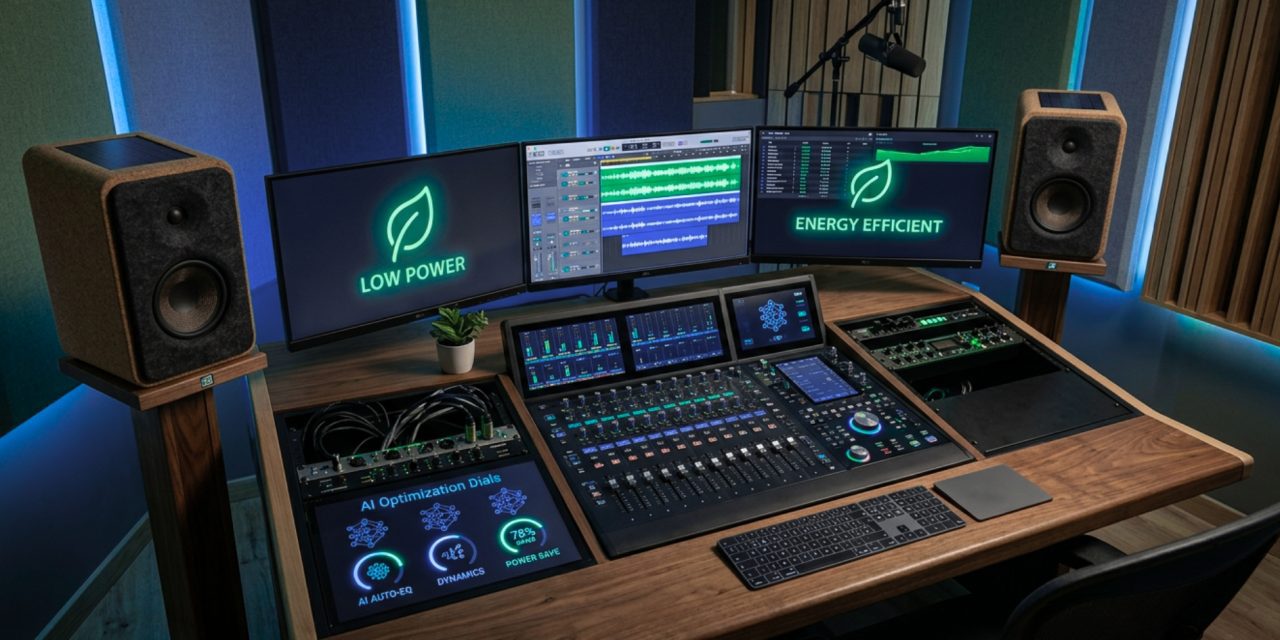
Eco-monitors are pushing serious innovation, with up to 75% lower energy draw thanks to technologies like E-Ink waveform displays and recycled materials. These systems align with Energy Star Displays v8.0 standards, making them ideal for producers who want performance without unnecessary power consumption.
Brands like Focal are experimenting with recycled glass speaker cones, while Adam Audio is advancing repairable display systems. The result is gear that lasts longer, sounds consistent, and fits naturally into modern studio workflows.
For producers, where long sessions and subtle sonic detail matter, these quieter, cooler-running systems help maintain focus without fatigue or rising energy costs.
E-Ink and Low-Energy Displays: Minimal Power, Maximum Clarity
E-Ink displays are redefining studio metering. Tools connected to platforms like Waves Central can run ultra-low-power meters that consume as little as 0.8mW when static, compared to roughly 12W from traditional LCDs.
They are not built for fast animation, but for VU meters and waveform monitoring, they excel. Wide viewing angles around 170 degrees also make them ideal in dim, ambient-heavy studios.
Compared to other display types, E-Ink prioritizes efficiency, LCD prioritizes speed, and OLED sits somewhere in between. For producers exploring solar-powered rigs or low-energy environments, E-Ink fits naturally into a sustainable workflow.
Recycled Glass Monitors: Sustainability Without Compromise
Speaker design is evolving too. Focal’s Trio11 Be monitors use 68% recycled glass cones, reducing environmental impact by up to 1.8 tons of CO2e per driver without sacrificing sound quality.
What makes this shift important is consistency. The frequency response remains within ±0.5dB, meaning your mixes retain clarity, balance, and translation across systems.
In music production, where texture and tonal subtlety matter, this level of accuracy is non-negotiable. You are not trading sound for sustainability—you are upgrading both.
Repairable OLED Panels: Gear That Actually Lasts
Repairability is becoming one of the most practical upgrades in modern studios. Adam Audio leads with OLED panels that are modular, accessible, and affordable to replace.
Instead of discarding an entire unit, producers can swap out a panel using simple steps—removing screws, disconnecting ribbon cables, and installing a replacement module. With kits priced around $29, this dramatically reduces long-term costs compared to full replacements.
For producers building long-term setups, this kind of durability is a quiet but powerful advantage.
Conclusion
Eco-friendly monitoring is not just about reducing energy use. Rather, it is about building a studio that feels intentional, efficient, and built to last. From ultra-low-power displays to recycled materials and repairable components, the focus is shifting toward smarter, more sustainable decisions.
In certain environments, where atmosphere and precision define the listening experience, these upgrades do more than save power. They support better focus, longer sessions, and a cleaner creative flow.
Ever thought about how much your studio setup is shaping your sound—and not just your electricity bill?
Stay plugged into smarter, cleaner, future-ready production moves and evolving studio trends only at DLK Music Pro News.