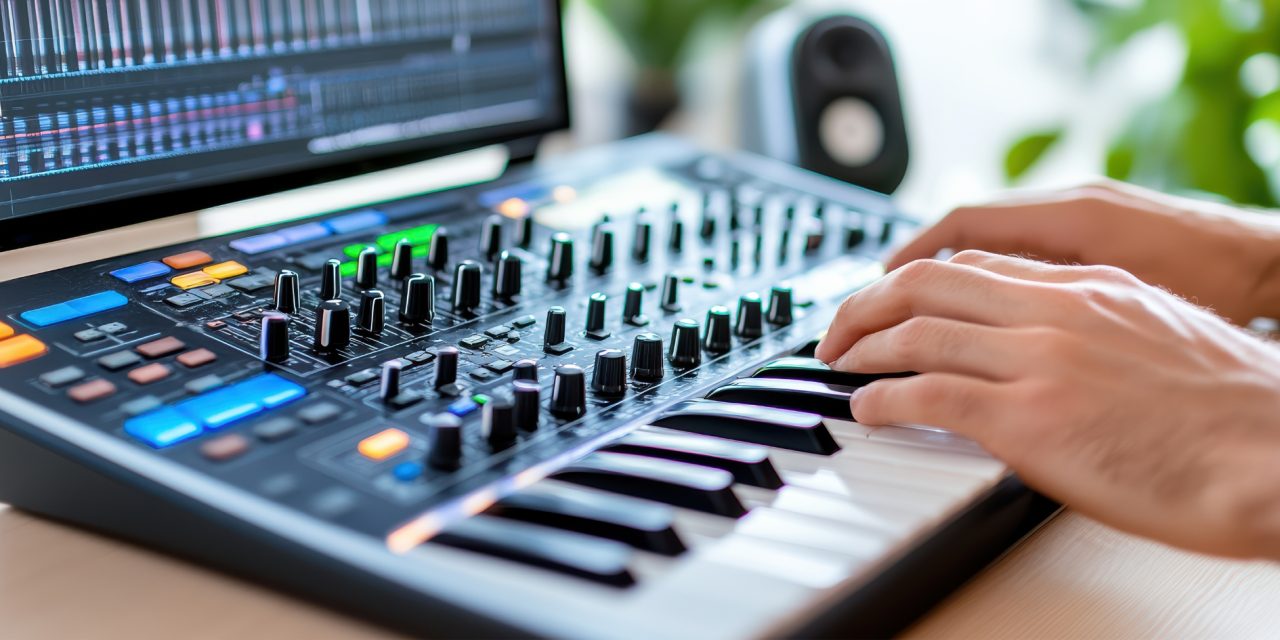
MIDI controllers used to be simple tools—pads, knobs, and keys that sent basic signals to software instruments. Today, artificial intelligence is beginning to transform them into adaptive instruments that respond to how musicians actually play.
Instead of static mappings and fixed control layouts, next-generation controllers can analyze gestures, anticipate musical patterns, and adjust parameters automatically. Research from organizations like Google Magenta shows how machine learning models can generate musical ideas and adapt performance input in real time.
By combining AI models, edge computing, and haptic feedback, modern controllers are evolving into interactive systems that learn from musicians rather than simply receiving commands.
Real-Time Gesture Recognition
Gesture recognition is one of the most exciting developments in MIDI controller design. Motion sensors and computer vision allow performers to control sound using hand movements and body gestures.
Devices like the Keith McMillen K-Board Pro 4 combine pressure-sensitive keys with motion sensing. These systems use IMU sensors and gyroscopes to track tilt, rotation, and movement.
Motion data is translated into MIDI commands through quaternion calculations and sensor fusion.
Key technologies include:
- IMU sensors detecting motion and acceleration
- Quaternion math converting movement to MIDI CC values
- Computer vision tracking hand positions
- Latency calibration for responsive live performance
Developers often pair gesture data with tools inside Ableton Live using Max for Live patches to route gestures into synth parameters.
For example, a swipe gesture can control a filter sweep, while hand tilts can modulate reverb or oscillator pitch.
This kind of interaction turns controllers into physical performance instruments rather than static input devices.
Predictive Note Generation
Artificial intelligence is also enabling controllers to assist with composition.
AI models developed by Google Magenta use neural networks like Music Transformer, RNN, and LSTM architectures trained on massive MIDI datasets.
One widely used dataset is the Lakh MIDI Dataset, which contains thousands of compositions used for machine learning training.
These systems analyze patterns in your playing and predict potential notes, chords, or sequences.
Typical workflow:
- A musician plays a short phrase.
- The model analyzes timing, harmony, and rhythm.
- The controller suggests notes or expands the pattern.
With dedicated AI chips like the Apple Neural Engine, predictions can occur in under 20 milliseconds, fast enough for live performance.
Combined with expressive hardware like MIDI Polyphonic Expression, predictive systems can react to pressure, pitch bends, and timbral gestures.
This allows controllers to behave more like collaborative musical partners than simple input devices.
Adaptive Learning From Player Habits
Another emerging feature is controllers that learn directly from user behavior.
Some modern music tools already experiment with adaptive workflows. For example, the ROLI Noise uses machine learning to analyze performance gestures and refine control mappings over time.
Instead of uploading raw user data, many systems rely on federated learning, where models train locally on the device.
Typical adaptive workflow:
- Capture performance sessions and controller movements
- Train machine learning models locally
- Sync model updates through cloud presets
- Automatically adjust control mappings
For example, if a performer repeatedly assigns a fader to control filter cutoff, the system may automatically apply that mapping during future sessions.
These intelligent adjustments improve workflow efficiency while preserving privacy.
As controllers integrate with DAWs like Logic Pro and Ableton Live, adaptive learning can personalize entire studio setups.
Bottom Line
The next generation of MIDI controllers will likely combine multiple AI technologies at once: gesture recognition, predictive composition, adaptive mappings, and real-time feedback.
These systems won’t just send MIDI messages—they’ll learn from musicians and evolve alongside their workflow. As AI becomes more integrated into music hardware, controllers will shift from simple control surfaces to intelligent creative instruments.
What will the next generation of music gear look like? Dive deeper into music technology at DLK Music Pro News.