A mix can sound incredible in the studio and completely fall apart in the car. Suddenly, that perfect bassline is either missing or trying to rearrange the entire dashboard.
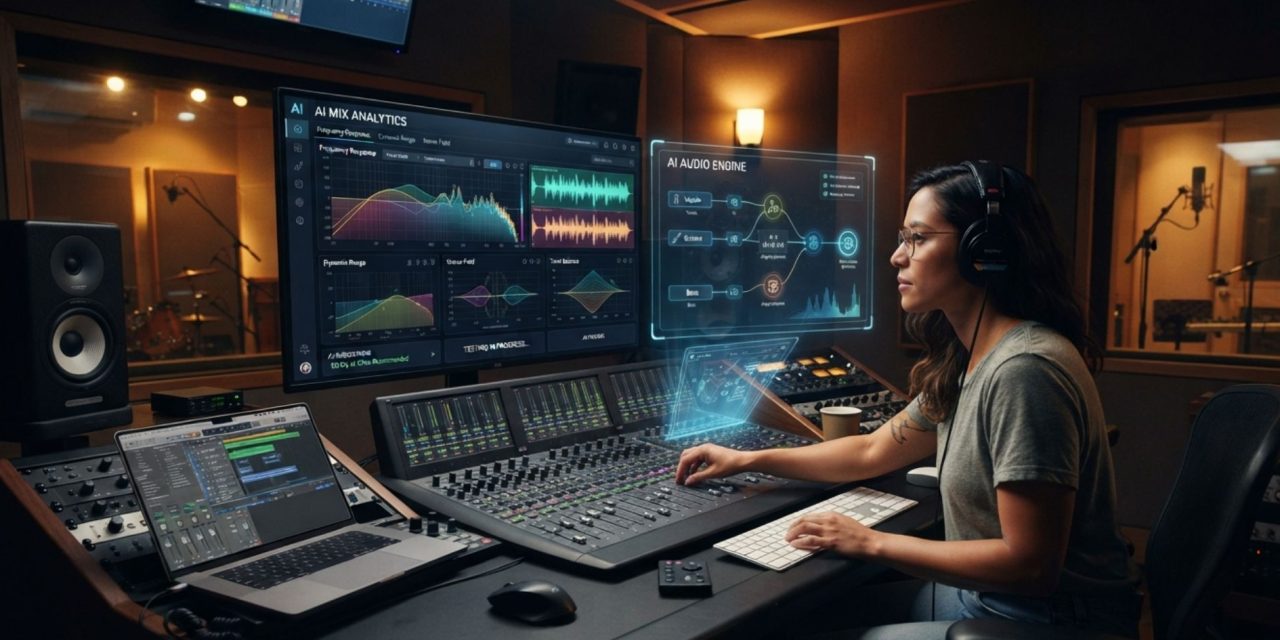
New monitoring technologies are tackling that problem with AI-powered endpoint simulation, room correction, and predictive modeling. Instead of physically checking every mix in a car, club, phone, or pair of headphones, engineers can increasingly simulate those listening environments from the studio.
Consumer Endpoint Simulation
One of the biggest developments in modern monitoring is the ability to simulate how a mix might sound through familiar consumer systems.
Instead of exporting a mix, driving around in the car, switching headphones, and testing multiple speakers, engineers can select virtual playback profiles and hear an approximation immediately.
Modern systems can model devices and environments such as:
- AirPods Pro
- Sonos speakers
- Smartphone speakers
- Bluetooth headphones
- Car stereos
- Laptop speakers
- TV soundbars
- Club PA systems
- Smart speakers
Each endpoint has its own frequency response, distortion characteristics, stereo behavior, and processing. A mix with perfectly controlled low end on nearfield monitors can therefore behave very differently on a bass-heavy pair of earbuds or a car system.
| Endpoint | Typical Characteristic |
| AirPods Pro | Adaptive EQ processing |
| Sonos Era 300 | Wide, room-filling dispersion |
| Bluetooth SBC | Compression artifacts |
| Car stereo | Strong low-frequency demands |
| Laptop speakers | Limited bass and high-frequency detail |
| Smart speaker | Voice-focused EQ |
| Club PA | High SPL and powerful low end |
| TV soundbar | Strong center-channel emphasis |
These simulations are particularly useful for identifying obvious translation problems before the mix leaves the studio.
Look closely at the bass response and stereo image. If the low end disappears on smaller speakers or becomes overwhelming in a car simulation, you have a problem worth investigating.
The goal isn’t to make the mix sound identical everywhere. That is impossible. The goal is to make sure the important musical information survives the journey.
Cross-Platform Response Modeling
The listening environment isn’t the only variable. Streaming platforms also process audio in different ways.
Normalization, loudness management, spatial processing, and encoding can influence how a finished track is perceived. That makes LUFS metering and true-peak monitoring increasingly important parts of a modern mixing workflow.
Engineers can use platform-aware monitoring to examine how a mix might behave after delivery.
For example, load a reference track into the DAW, enable the relevant playback simulation, and compare:
- Overall loudness
- True peak levels
- Bass response
- Stereo width
- Vocal placement
- Soundstage
- Dynamic range
This creates another layer of quality control before release.
A mix that sounds balanced in the studio but becomes excessively bright or loses its center image after simulated processing deserves another look.
Predictive Translation Algorithms
The most interesting development is the use of machine learning to predict how mixes will behave outside the studio.
These predictive translation algorithms combine several forms of modeling. They can account for room acoustics, monitor response, consumer playback characteristics, and aspects of human hearing to produce a simulated listening environment.
The workflow can be surprisingly simple.
Start with your stereo mix on calibrated nearfield monitors. The monitoring system applies its room correction and selected endpoint profile. You then listen for problems that might appear on that simulated system.
This doesn’t eliminate the need for real-world testing. It simply makes the first round of testing much faster.
Blind listening tests and actual consumer playback remain valuable because simulations are still models rather than perfect copies of physical environments.
Room Correction Still Matters
Endpoint simulation cannot compensate for a poorly calibrated monitoring environment.
Before relying heavily on virtual playback profiles, engineers should establish a reliable baseline in the studio. Room correction systems such as Dirac Live and Sonarworks can help address problematic frequency response caused by the room and speaker placement.
This is particularly important in the low end, where room modes can make certain frequencies appear dramatically louder or quieter than they actually are.
A sensible workflow is:
- Calibrate the room before evaluating translation.
- Use a trusted reference track to establish a target.
- Check the mix on nearfield monitors at a consistent listening level.
- Simulate consumer endpoints such as earbuds, phones, and cars.
- Investigate recurring problems rather than correcting every individual simulation.
- Confirm important changes on physical devices before final delivery.
That last step matters. If every virtual system says the same thing, you’ve probably found a genuine mix issue. If only one simulation complains, don’t immediately rebuild the entire mix around it.
The New Mix-Checking Workflow
The real breakthrough isn’t that engineers can suddenly predict every speaker on earth.
It is that mix translation can become a much more systematic part of the production process.
Instead of relying entirely on memory—“I think this will sound okay in the car”—engineers can gather information from multiple simulated environments before committing to a final master.
A practical workflow might look like this:
Studio → Room Correction → Reference Comparison → Endpoint Simulation → Streaming Simulation → Physical Confirmation
That combination saves time while keeping real-world listening tests in the process.
For producers working without access to expensive studios, this could be particularly valuable. A well-calibrated monitoring setup paired with reliable simulation tools can provide a much broader picture of how a mix may translate.
Conclusion
Mix translation has always required engineers to think beyond the studio. What is changing is how quickly they can test that thinking.
AI-powered monitoring, room correction, endpoint modeling, and platform-aware metering are bringing more of those listening environments directly into the production workflow.
They won’t replace good ears—or the occasional car test. But they can make the journey from “sounds great here” to “sounds great almost everywhere” considerably more predictable.
What if you could catch the car-speaker problem before you even leave the studio? Discover more of the monitoring technologies, production tools, and audio innovations changing how modern mixes get made on DLK Music Pro News.