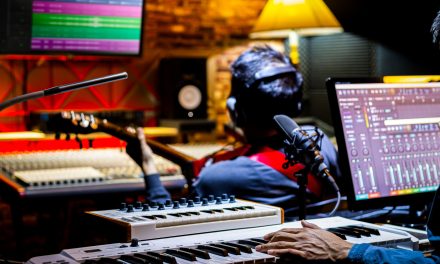
Studio monitoring is no longer limited to a pair of speakers connected by analog cables. Network audio, DSP, and software control are changing how engineers manage their monitoring workflows.
As studios adopt more connected systems, studio monitor workflow integration is becoming increasingly important. Dante and other audio-over-IP technologies can simplify routing, while monitor-management software makes calibration and configuration easier to recall.
The result is a monitoring environment that can be more flexible, organized, and adaptable to modern production demands.
Connectivity and Workflow Integration
Network audio can reduce the need for traditional point-to-point cabling while giving engineers more flexible ways to route audio around a studio. Cloud-based collaboration can also make it easier for teams to exchange project information and calibration settings, although these systems depend heavily on the specific equipment and software being used.
Dante is particularly useful in larger networked environments because it provides synchronized digital audio transport with predictable latency. Audinate notes that Dante’s typical network contribution can be around 150 microseconds, while actual system latency depends on the devices and network configuration.
This matters when multiple monitoring devices, interfaces, computers, and rooms need to communicate without creating a maze of physical connections.
Modern monitoring workflows can therefore combine:
- Dante and other network-audio protocols.
- AES67 interoperability where supported.
- DSP-based room correction and monitor management.
- Software-controlled monitor switching and calibration.
- Networked connections between rooms and production systems.
Instead of treating the speakers as isolated pieces of hardware, engineers can increasingly incorporate them into a wider studio network.
Dante, AES67, and Networked Audio Standards
Dante has become an important part of professional networked-audio workflows, while AES67 provides an interoperability standard for high-performance audio-over-IP systems.
The two can work together in compatible environments, although implementation depends on the equipment and firmware involved. Audinate’s current documentation confirms Dante’s support for AES67 and its use of PTP-based clock synchronization across networked systems.
AVB takes a different approach, using time-sensitive networking technologies designed to provide synchronized, deterministic transport.
For studios, the practical question is less about choosing the most impressive specification and more about choosing the system that fits the existing infrastructure.
Dante can be particularly useful when a studio needs flexible routing across multiple rooms. AES67 can help when interoperability with other compatible network-audio equipment is important. AVB can make sense in environments already built around compatible networking hardware.
Network design also matters. Large Dante installations require careful attention to subnetting, clocking, switching, and device capabilities. Current Audinate guidance notes that device capacity depends on the hardware acting as clock leader rather than simply supporting an arbitrary number of devices.
For engineers, that means reliable monitoring starts with proper network planning rather than simply connecting everything to the same switch.
DAW-Native and Software Monitor Control
Software control is another major part of modern monitoring workflows.
Monitor-management systems can provide functions such as input selection, level control, calibration recall, and speaker switching without requiring engineers to constantly reach behind equipment or change physical connections.
Genelec’s GLM system, for example, allows compatible Smart Active Monitors and subwoofers to be measured, controlled, and calibrated through software. The system analyzes the room at the listening position and calculates DSP settings to compensate for room-related effects.
This approach can make repeated monitoring tasks much easier.
An engineer might switch between different monitor configurations, recall a calibrated setup, or compare monitoring conditions without rebuilding the physical signal path each time.
For long mixing and mastering sessions, that kind of workflow efficiency can be just as valuable as another piece of studio hardware.
It also makes repeatability easier. If a room has several monitoring configurations, saved settings can help engineers return to a known reference instead of relying on memory.
Cloud-Based Calibration and Remote Collaboration
Cloud-based workflows are also becoming more relevant as production teams work across different locations.
However, calibration sharing should not be treated as a universal feature built into every modern monitor system. Different manufacturers and software platforms offer different approaches to storing, recalling, or sharing settings.
A more realistic workflow involves combining calibration software, saved room profiles, project documentation, and collaborative production tools.
For example, an engineer could document a room’s calibration settings, share those settings with another engineer, and then verify the result independently in the second environment.
That final verification remains important.
A calibration profile cannot physically transform one room into another. Room dimensions, speaker placement, acoustic treatment, listening position, and equipment all affect the final result.
The goal is therefore consistency, not pretending that every studio will sound identical.
For remote teams, this can still be valuable. Engineers can maintain clearer reference points when moving between rooms or handing projects to collaborators.
Conclusion
Studio monitor workflow integration is becoming an increasingly important part of modern music production. Network audio, DSP, software control, and calibration tools are giving engineers more flexible ways to manage complex monitoring environments.
Dante and AES67 can simplify networked audio transport, while systems such as Genelec’s GLM demonstrate how software can bring calibration and speaker management into the wider studio workflow.
The most useful systems will not necessarily be the ones with the biggest specifications. They will be the ones that make monitoring easier to control, easier to repeat, and easier to trust.
Would you rather have fewer cables, faster monitor switching, or calibration you can recall instantly? Follow the technology behind modern studio workflows with DLK Music Pro News.