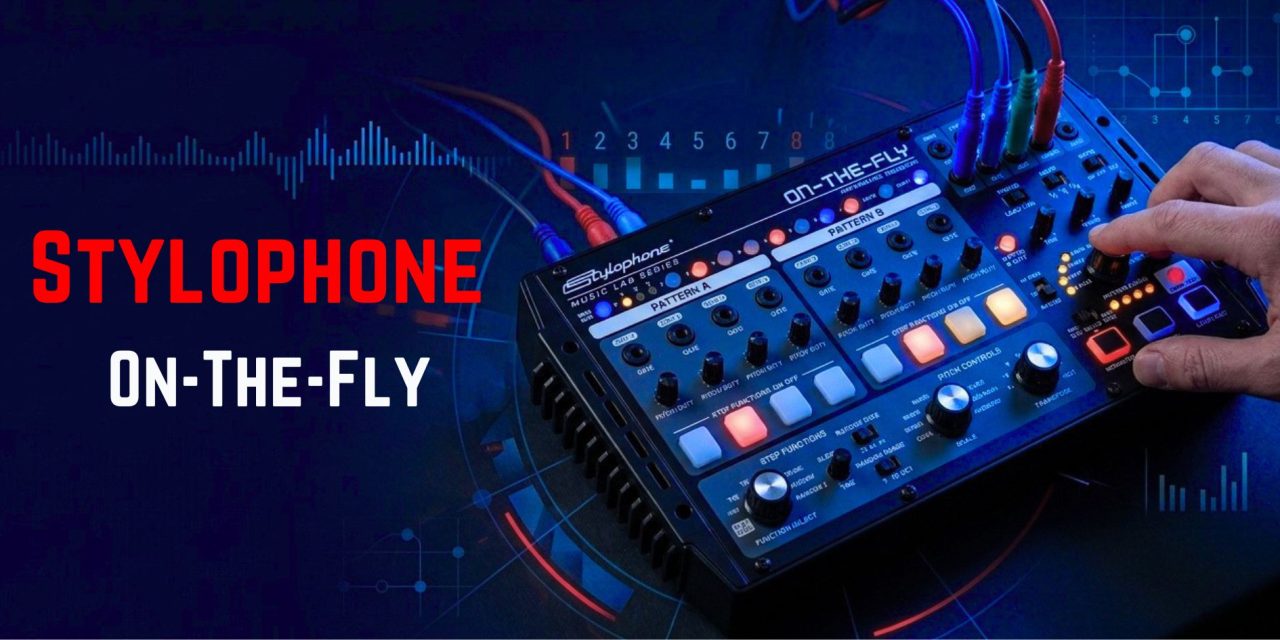
Stylophone has officially launched its On-The-Fly Performance Sequencer, with a November 5, 2026 introduction and Sonicstate confirming that shipping began on the same date. Previously previewed at NAMM in January, the hardware now arrives with a clear musical proposition: change the sequence while it plays.
For producers who build tracks around repeating patterns, the interesting question is how those patterns develop into arrangements. On-The-Fly puts direction changes, step effects and timing controls directly on the hardware, giving performers several ways to develop an idea without stopping playback.
Eight Programmed Steps, Longer Musical Structures
Sonicstate’s demonstration describes two four-step patterns, A and B, that combine into longer structures. Stylophone’s current documentation lists 16-, 32- and 64-step sequences, with eight switchable pattern chains.
That distinction matters because the initial eight steps can be organized into longer playback patterns. The instrument isn’t simply asking producers to enter an entirely new phrase whenever they want to introduce movement.
Forward, Reverse and Bounce directions offer another way to reshape the material. For a producer developing a bass or melodic part, a useful rehearsal exercise would be to keep the sound unchanged and explore how direction alone alters the phrase. This is a creative suggestion and not a report from hands-on testing.
Variation Becomes Part of the Performance
The official product page lists Skip, Rest, Tie, Slide, Ratchet and Random controls, alongside scale and transpose settings. Tempo, swing, lead/lag timing, note length and gate length provide further ways to shape the pattern.
These controls invite a practical approach to arranging: establish a recognizable phrase, introduce one variation, then return to the original. Changing every parameter at once can make it harder to understand which gesture is doing the musical work. Rehearsing a few deliberate transitions can make a small pattern more useful than a complicated sequence that is hard to navigate confidently.
Pattern Memory and Loop Record Are Different Tools
Current manufacturer specifications list 24 sequence memories. Separately, Loop Record captures up to 128 steps of a performance, with 24 loop recording memories. Sonicstate describes recording front-panel parameter movements as part of that process.
For studio planning, consider the difference between recalling a pattern and capturing the way it changes. Sequence memories preserve programmed patterns for later recall, while Loop Record captures the performance gestures used to manipulate them. The latter can help preserve a sequence of changes for further arrangement.
Loop Record should not be confused with recording a microphone or an audio performance. Its focus is on capturing the sequencer’s control movements.
Check the Connections in the Whole Rig
Stylophone lists MIDI, CV, Gate and Sync connections, including eight individual step gate outputs and a summed gate output. According to Sonicstate, the unit can work in desktop setups or be mounted in Eurorack.
Before integrating any hardware sequencer, map the instruments it will control and decide which device provides the clock. Check the current manual for the required cables, signal types and power supply. A connection label alone does not establish compatibility with every instrument or studio configuration.
The appeal of On-The-Fly is its emphasis on physical control of a repeating musical idea. Its launch gives producers a new option to evaluate for that role, particularly those interested in introducing variations without interrupting playback. Whether its layout, timing behavior and performance capture suit a particular workflow still calls for a demonstration or hands-on assessment with the intended setup.
What other tools could change the way producers create music? Follow the latest developments in music production technology, studio hardware and the wider music industry on DLK Music Pro News.