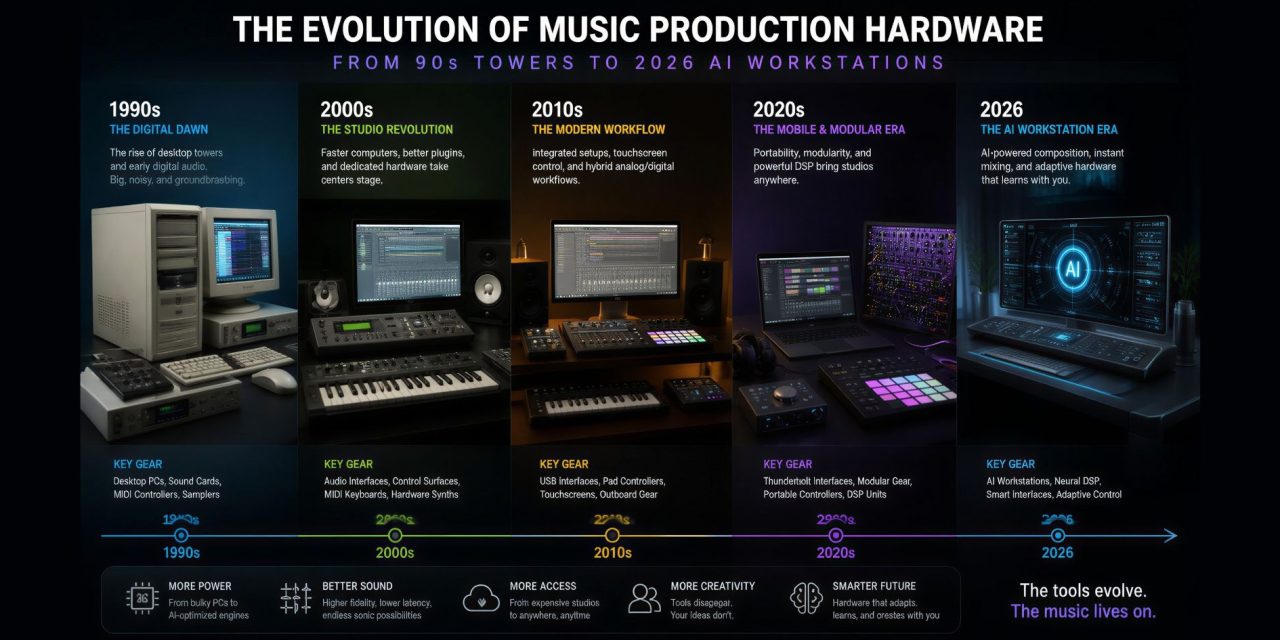
Back in the 1990s, music production hardware looked less like a creative setup and more like someone accidentally turned a server room into a recording studio. Massive towers, deep rack units, tangled cables, overheating processors, and enough blinking lights to convince you the studio might launch into orbit at any moment.
Fast-forward to 2026, and production hardware has gone through a dramatic transformation. Modern music workstations are slimmer, quieter, faster, and far more powerful, with AI-assisted processing, unified memory systems, and real-time immersive audio workflows now fitting into compact studio setups that would have seemed impossible twenty years ago.
Read on to explore how music production hardware evolved from heavy Pentium Pro towers into the ultra-integrated creative workstations shaping modern studios in 2026.
From Massive Towers to Compact Production Systems
Early music production setups depended heavily on oversized rackmount systems and bulky desktop towers. Studios in the late 90s often revolved around dual-processor Pentium Pro machines connected to external audio interfaces, MIDI racks, hard drives, monitor controllers, and hardware samplers through what felt like several kilometers of cable management suffering.
By the mid-2000s, modular desktop systems became more practical for project studios. Processors like the Athlon 64 helped producers run larger DAW sessions while supporting expanding VST libraries and software instruments. Upgradable RAM, GPU acceleration, and faster storage gradually turned home studios into legitimate professional production environments.
Then came the era of compact performance computing.
Apple’s Retina iMac designs, followed by Apple Silicon systems and high-efficiency GPU architectures, dramatically reduced the physical footprint of modern production rigs while increasing overall processing power. Producers could suddenly run orchestral templates, real-time mastering chains, and immersive audio sessions from setups that occupied a fraction of the space older studios required.
Hardware Evolution Timeline
| Year | Milestone | Size/Weight Reduction |
| 1997 | Pentium Pro Towers | 75 lbs, 4U depth |
| 2005 | Athlon 64 Dual-Core | 45 lbs, 2U equivalent |
| 2012 | iMac Retina | 21 lbs, 0.8″ thick |
| 2020 | M1 Ultra | 12 lbs, 0.6″ panels |
| 2026 | Unified Systems | 18 lbs, 1.5″ thick |
The Technology That Changed Modern Production
Several breakthroughs pushed music hardware toward the all-in-one production systems now dominating modern workflows.
Thunderbolt connectivity dramatically improved transfer speeds for sample libraries and external drives. DDR5 memory increased plugin efficiency during large sessions. PCIe 6.0 expanded bandwidth for hybrid audio-video workflows, while modern GPUs introduced real-time rendering capabilities for immersive formats like Dolby Atmos.
Perhaps the biggest shift came from unified system architecture.
Instead of relying on separate CPU, GPU, and memory bottlenecks, modern workstations increasingly combine processing resources into highly optimized systems that reduce latency while improving energy efficiency. That matters heavily for producers running massive sessions with virtual instruments, real-time effects processing, and AI-assisted tools simultaneously.
And honestly, the fact that producers can now run sessions that once required entire commercial studios from a desk beside a houseplant still feels mildly ridiculous in the best possible way.
Key Milestones Leading to 2026 Production Systems
The road to modern production hardware came through several major technological jumps:
| Year | Advancement | Production Impact |
| 2018 | Thunderbolt 3 | Faster sample library streaming |
| 2020 | Apple M1 Chips | AI-assisted audio processing |
| 2022 | DDR5 RAM | Improved plugin hosting |
| 2024 | PCIe 6.0 | Faster hybrid audio/video workflows |
| 2025 | Blackwell GPUs | Real-time immersive audio rendering |
| 2026 | Unified Memory Systems | Lower latency, all-in-one workflows |
These developments now allow producers to handle tasks like Dolby Atmos mixing, film scoring, virtual orchestration, machine-learning audio tools, and complex mastering chains from increasingly portable studio environments.
Conclusion
Music production hardware has evolved dramatically from the oversized rack systems of the 1990s into compact, AI-assisted workstations capable of handling massive creative workloads in 2026. Faster processors, unified memory systems, immersive audio support, and streamlined workflows are reshaping how producers build and use modern studios.
And the pace of change is only accelerating.
Which production hardware shift changed your workflow the most: faster processors, compact setups, AI-assisted tools, or unified workstation systems?More studio workflow breakdowns, production technology discussions, and modern music creation insights are waiting at DLK Music Pro News.