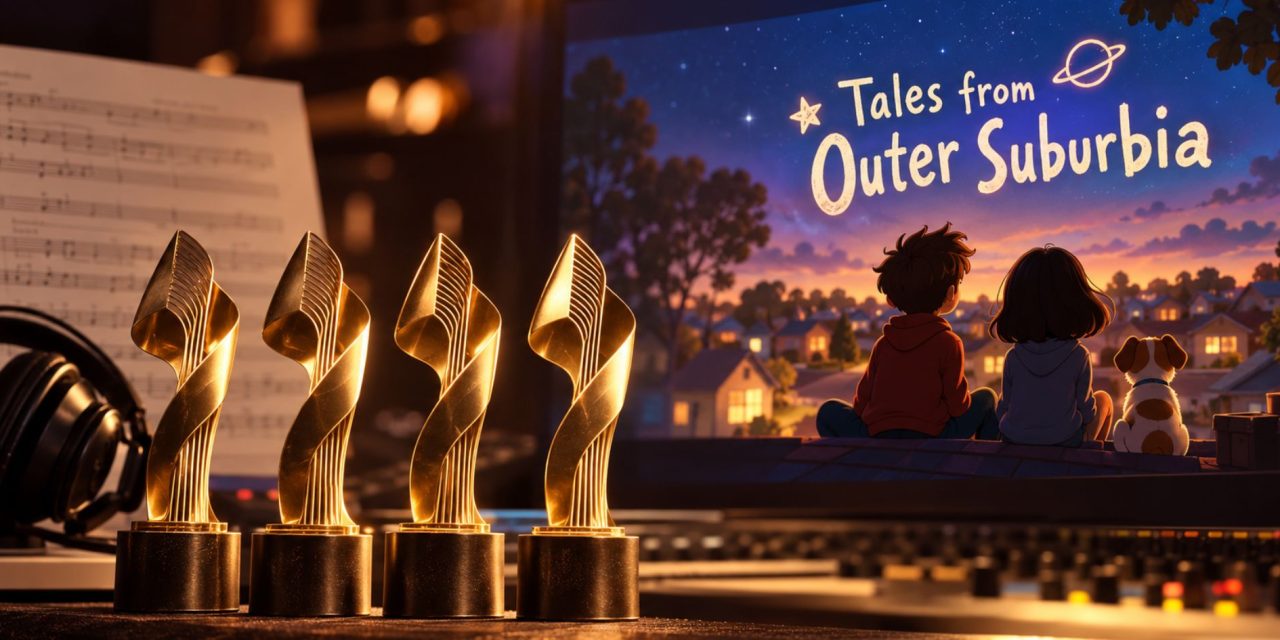
Josh Hogan and Ned Beckley won four awards at the 2026 Screen Music Awards for their work on Tales from Outer Suburbia. Announced in Brisbane on October 28, the results recognized their work across children’s programming, opening-title music, a soundtrack album, and an original song.
The APRA AMCOS announcement confirms all four wins. The original song award also credits Joni Hogan for “Nothing Stays the Same,” as reported by ABC News. For producers, the result offers a useful way to distinguish four musical deliverables that can emerge from one screen project.
Which Four Awards Did They Win?
Hogan and Beckley won all four categories in which they were nominated for the ABC animated series Tales from Outer Suburbia:
- Best Music for Children’s Programming: For Tales from Outer Suburbia, Episode 10.
- Best Opening Title Television Theme: For the series’ opening-title music.
- Best Soundtrack Album: For the Tales from Outer Suburbia soundtrack album.
- Best Original Song Composed for the Screen: For “Nothing Stays the Same,” shared with Joni Hogan.
These categories recognize different forms of screen music. The awards confirm the credited work and results, but they do not reveal the composers’ exact creative processes or the judges’ reasons for selecting each winner.
How Do the Four Musical Jobs Differ?
The categories offer a practical framework for understanding what a screen-music brief might require. Each deliverable serves a different purpose, even when the work belongs to the same production.
1. Music for Children’s Programming
The award for Episode 10 recognizes music composed for a specific installment of the series. In general production practice, episode cues need to work with the picture, dialogue, sound effects, and timing of individual scenes.
For producers, the brief should establish where music is needed, what the scene requires, and how cues must fit the edit. Those are general planning considerations, not claims about the techniques Hogan and Beckley used for this episode.
2. An Opening-Title Television Theme
An opening theme helps establish a program’s identity within its title sequence. Its timing, musical character, and relationship to the opening visuals all matter when defining the brief.
Producers should confirm the sequence’s duration, any required start or end points, and whether the music must accommodate changes to the title edit. A theme may also need to work as a recognizable musical identity beyond its initial appearance, depending on the production’s requirements.
3. A Soundtrack Album
A soundtrack album presents music from a screen production as a listening experience in its own right. Unlike cues designed primarily to support scenes, an album sequence needs to make sense when heard away from the picture.
Track selection, ordering, transitions, and overall pacing are useful review points. Producers should also clarify which music is approved for release and whether the album requires edits or versions different from those used in the program.
The award confirms recognition for the Tales from Outer Suburbia soundtrack album. It does not establish which tracks were selected or how the album was sequenced.
4. An Original Song Composed for the Screen
The original-song category recognizes “Nothing Stays the Same,” credited to Ned Beckley, Joni Hogan, and Josh Hogan. Joni Hogan therefore shares the award with the other two composers.
A song brief can involve different considerations from an instrumental cue, including lyrics, songwriting credits, vocal requirements, and how the song fits the scene. Producers should establish authorship and approval responsibilities early, especially when multiple collaborators contribute.
The award announcement confirms the song and its credits. It does not, by itself, explain how the collaborators divided their work.
Where Composition and Audio Post Meet
Hogan and Beckley’s work also sits within a broader audio-production practice. Their Envelope Audio project page lists original music composition alongside audio post, dialogue editing, sound design, Foley, and mixing for Tales from Outer Suburbia.
That information provides context for producers considering how music and other soundtrack elements fit together. Composition develops the musical material; audio post encompasses other tasks involved in shaping the production’s sound. The listed services show the scope of Envelope Audio’s credited work on the project, but they do not establish how responsibilities were divided between individual team members.
Envelope Audio’s studio biography also describes work across screen, installation, and interactive media. It identifies Hogan as a composer, producer, and sound designer, and connects Beckley’s practice with electronic performance. These details offer professional context without implying that any particular technique was used on the award-winning work.
What Can Producers Check in Their Own Briefs?
The four awards offer a straightforward reminder: one screen project may require several distinct musical outputs. Before production begins, identify each deliverable and agree on its purpose, approval process, and delivery requirements.
Use this checklist when preparing or reviewing a brief:
- Episode cues: Identify the scenes, timings, picture references, and dialogue or effects considerations.
- Opening theme: Confirm the title sequence duration, edit points, and any requirements for alternate versions.
- Soundtrack album: Agree on track selection, sequence, release scope, and any album-specific edits.
- Original song: Confirm songwriting credits, lyric and vocal requirements, collaborator approvals, and intended use.
Not every production will need all four deliverables. The point is to define the actual scope instead of assuming that a request for “the music” covers every version and use.
It is also worth keeping credits tied to the relevant work. “Nothing Stays the Same” has three credited composers, while the other three award categories recognize Hogan and Beckley. Clear records help teams track authorship and approvals without conflating different contributions.
The Takeaway for Screen-Music Producers
Josh Hogan and Ned Beckley’s four wins for Tales from Outer Suburbia demonstrate how one production can receive recognition across episode music, opening-title music, a soundtrack album, and an original song. Joni Hogan’s shared credit on “Nothing Stays the Same” also highlights the importance of identifying song collaborators accurately.
For producers, the practical lesson is to treat each deliverable as its own part of the brief. Clear scope, appropriate review criteria, and accurate credits help everyone understand what the music needs to do and how each contribution will be recognized.
When one screen project calls for episode music, an opening theme, a soundtrack album, and an original song, how do producers keep each deliverable on brief while making sure every collaborator receives proper credit?
Explore more music production insights and behind-the-scenes industry stories only on DLK Music Pro News.