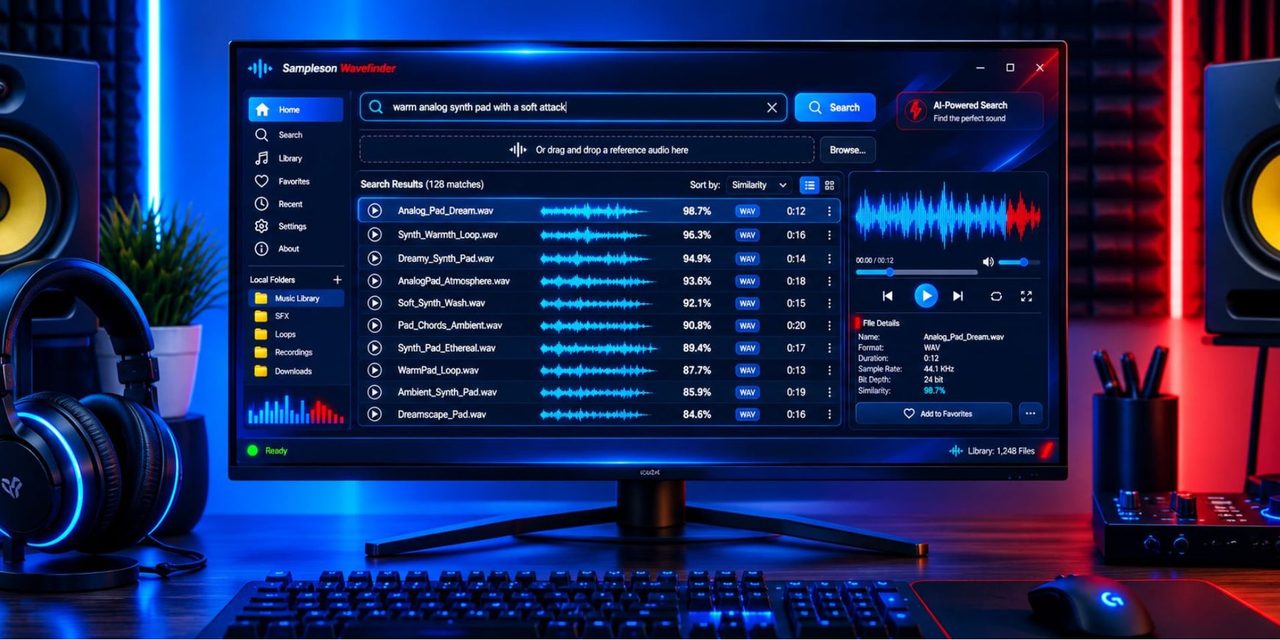
Sampleson has released Wavefinder, a local AI-powered audio search tool that helps producers find sounds by describing them or supplying a reference clip. Instead of relying on filenames, the application analyses audio and ranks matches by sonic similarity within a user’s existing library.
KVR Audio reported the launch on November 4, 2026. Wavefinder is the first project from sampleson_devs, which Sampleson describes as a space for DSP experiments outside its usual instrument catalog. For music makers, the key question is whether this alternative search method can uncover useful material without interrupting a session.
Two Ways to Search the Same Audio Collection
According to the official Wavefinder product page, the application builds a local index of selected audio folders, including their subfolders. Users can search with a written description or supply a reference clip. Wavefinder then ranks matching files by sonic similarity.
Supported formats include WAV, AIFF, FLAC, OGG, and MP3. The index is stored locally, and newly added material requires re-indexing before it becomes available in searches.
A written description can communicate the character of the sound you need. You might search for a short, dry percussion hit or a slowly changing background texture. A reference clip offers another starting point when you already have something close to the desired result. Instead of describing it, you let Wavefinder look for similar sounds in your collection.
Both approaches offer a way around inconsistent filenames and folder structures. However, neither removes the need to audition the candidates against the actual arrangement.
Searching Is Still a Musical Decision
For an initial evaluation, start with a manageable folder whose contents are familiar. Try several descriptions for the same musical role, then compare the returned sounds. A broad prompt may encourage exploration, while a more specific description can help when the arrangement leaves little room for alternatives.
Next, use a known file as a reference and assess the results. Listen for the qualities that matter to the part, including attack, decay, texture and room sound. A similar result may still occupy too much space, feel wrong against the groove or compete with another instrument.
These are suggested evaluation steps, not results from a Wavefinder test. The aim is to establish whether sound-based searching makes it easier to discover useful material in a library you already know.
It is also worth keeping track of promising candidates and their original locations. A search index helps locate material, but a clear project structure helps collaborators understand what was actually used. Before archiving a finished session, confirm that its chosen audio assets remain available with the project.
Local Search, With an Activation Distinction
Sampleson says Wavefinder’s AI model and search index operate on the user’s computer. Audio files are not uploaded for searching, and the product does not require cloud-based searches or usage tokens.
The application is available as a standalone tool for Mac and Windows, as well as in plug-in formats for use inside a DAW. There is a platform distinction worth checking before installation: the Mac version includes standalone, VST3 and AU formats, while the Windows version includes the standalone application and a 64-bit VST3 plug-in. The host must support the relevant plug-in format.
The official system requirements also list macOS 10.13 or later, Windows 10 or later, 4 GB of RAM and 400 MB of storage. Online activation is required.
That last point matters when describing the product’s local operation. Audio processing and searching happen on the computer, but this does not mean installation or activation never requires an internet connection. Sampleson’s description explains its stated architecture; it is not an independent security audit.
Evaluate the Results Before Changing Your Workflow
The useful comparison is with the way you search your audio library today. Can a written description uncover a forgotten sound? Does a reference clip reveal an alternative worth trying? And can you do this without losing momentum once the sound is placed in the song?
Wavefinder offers another route through existing audio, rather than another collection of sounds to buy or manage. Its value will depend on the size and organization of the library, the descriptions or reference clips used, and the producer’s judgment about what the music needs.
What sound is usually the hardest to track down in your own sample library? It is the kind of everyday studio problem worth exploring as music-production tools evolve. Follow more developments in audio software, recording technology and creative workflows through DLK Music Pro News.